
Table of Contents
- The historical context of organized labor activity and regulation
- The prevalence, presence, and coverage of unions
- Understanding labor relations laws
- The roles and responsibilities of labor relations professionals
- Major and emerging organizational labor relations challenges
- Unique requirements, demands, and knowledge from labor relations professionals
- Programs and solutions that support a constructive labor relations environment
- Relevant Practices & Tools
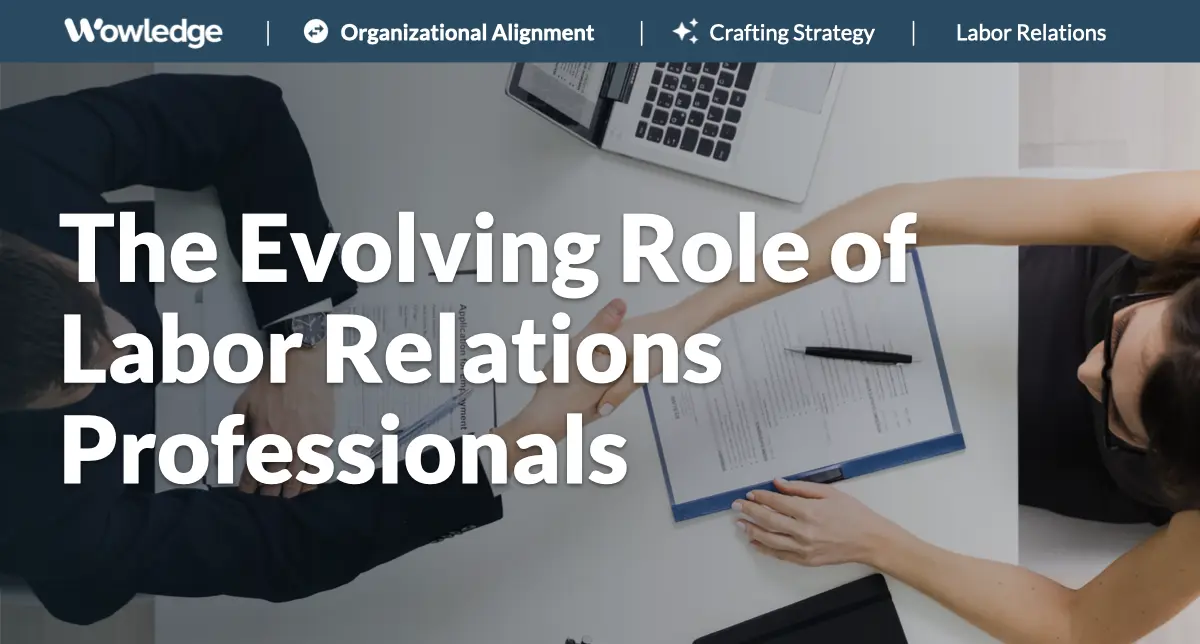
Labor relations professionals in both private and public employers are essential to a modern, responsive, and impactful HR capability across financial, operational, and talent levels. Balancing positive, constructive relationships, labor costs, and employee productivity can be a juggling act, but it drives success in some of the fastest-growing and hardest-to-staff industries.
Labor relations professionals serve as a conduit between management teams, represented employees, and the unions themselves, interpreting labor laws and contract provisions; negotiating and communicating policies and practices defined by those; monitoring and ensuring compliance by both parties; and resolving conflicts and differences in their positions.
While most frequently managed by, and requiring many of the foundational capabilities and skills common to their peers in the Human Resources function, they bring specialized knowledge, skills, and abilities that make them unique and harder to develop. The primary issue is the relative paucity of opportunities, with the Bureau of Labor Statistics (BLS) estimating only 66,300 labor relations specialists employed in the U.S. The need to understand a different set of laws and regulations makes knowledge and skills transferability even more challenging.
The historical context of organized labor activity and regulation
Unionization has a long history in the U.S., with roots in craft guilds and associations first established in colonial America in the 1600’s. These local, trade-specific groups, which trace their roots further back to European guilds, were established to structure standardized apprenticeships, set wage levels, and protect the interests of their trades. They rose to prominence during the Industrial Revolution, when mass production and large-scale employment of similarly skilled and leveled employees became commonplace. Their mission shifted somewhat to protecting worker safety and fair treatment related to wages, hours, and benefits.
That focus (and influence) evolved as manufacturing grew, then shifted and waned because of advances in automation, increased pressure to optimize costs, the post-WWII rise in educational levels and the attractiveness of white-collar roles, and the U.S. economy's inevitable move toward a knowledge economy. At the same time, U.S. presidential administrations and congressional majorities have held positions that were differentially supportive of or opposed to the power unions held (commercially and politically). These led to legal and regulatory changes that impacted union representation.
Currently, severe labor shortages and selective union organizing that targets non-traditional industries and professions are keeping unions relevant. Economic disparities between top executives and the lower-level workers are creating riper grounds for such collective action.
The prevalence, presence, and coverage of unions
Unionization is based on the concept of “collective bargaining”, where a group of employees jointly negotiate terms, conditions, and benefits of their employment with the organization. They do so under a collective bargaining agreement (CBA) or contract negotiated after voting and receiving legal approval as a certified labor union.
Per the BLS, an estimated 11.2% of U.S. workers are covered by CBAs. Union membership rates are substantially higher in the public sector than in the private sector (32.9% vs. 5.9%). The Economic Policy Institute reports that public employer unionization rates are highest in education and public safety occupations at the federal, state, and local government levels. In the private sector, union representation is most prevalent in education, health services, transportation, utilities, and manufacturing.
CBAs, or union contracts, have a defined coverage period and include agreements between the employer and employees on four core elements related to covered workers' employment. These include:
Wages
Sets the pay rates for workers at each job level, including increases based on job grade or steps, special enhancements for unusual work (danger, remote, holiday), annual cost-of-living or merit increases, bonuses, and any additional income opportunities.
Employee benefits
Provides access to the traditional corporate-subsidized health, wellbeing, retirement, and paid time off benefits at levels and rates negotiated specifically for the covered workers. These can include coverages for medical, dental, vision, prescription, 401K and/or pension, vacation, holiday, sick, and personal time off.
Working conditions
These are guardrails against unsafe, unhealthy, or unfair work environments, management practices, and hours and scheduling. The union negotiates modern health and safety standards and procedures; fair, non-arbitrary management processes and standards; and clear rules and criteria for break times and shift and schedule assignments.
Job protections
Employee relations policies and “just cause” standards are negotiated and defined separately for hiring, probationary periods, disciplinary actions, terminations, or layoffs. These include performance standards and evaluation processes, layoff protections and recall provisions, and formal grievance and arbitration processes employees can use to challenge decisions that negatively affect their employment status.

Understanding labor relations laws
Labor relations professionals must become experts in the standards and requirements established in federal laws related to collective bargaining activities and agreements, as well as the legal rulings and interpretations that arose from subsequent clarifications from judicial tests and challenges. In addition, they must be fully aware of and conversant with relevant state and local laws in the jurisdictions where they have employees working under union contracts. The National Labor Relations Board (NLRB) and the Federal Mediation and Conciliation Service (FMCS) enforce these laws and support conciliation of contract negotiations and disputes. The guiding laws include:
National Labor Relations Act (NLRA)
The NLRA encompasses the Wagner Act and its post-1935 amendments that established the rights of employees to unionize, bargain collectively, and participate in “concerted activities”, or act on behalf of their coworkers to improve their pay, work hours, safety, and working conditions. The law excludes supervisory and managerial employees, state and local government employees, and agricultural employees (and all contractors).
Labor Management Relations Act (LMRA)
Also referred to as the Taft-Hartley Act of 1947, this updated the NLRA to bring a better balance between the rights of companies and unions by codifying and prohibiting unfair labor practices by unions, establishing the rights and choices of employees not to join a union, and granting states the ability to pass "right-to-work" laws.
Labor-Management Reporting and Disclosure Act (LMRDA)
Alternatively known as the Landrum-Griffin Act, it established a union members’ “bill of rights” to protect them from union corruption, requiring unions to maintain equal, anonymous voting rights and freedom of speech and due process. It further codified and required transparency in union financial activities and reporting, formalized governance through the adoption of constitutions, and provisions that maintain local union independence from national (“parent”) organizations.
Railway Labor Act (RLA)
Establishes employees' right to bargain collectively in interstate railroad and airline industries and governs those agreements to prevent interruptions to interstate commerce and avoid labor disruptions and strikes. Created administrative panels that oversee and manage union elections, certifications, mediations, and arbitration activities.
Federal Service Labor-Management Relations Statute (FSLMRS)
Part of the Civil Service Reform Act of 1978, this establishes and protects the rights of federal government employees to organize and bargain collectively.
State labor relations laws
Over 20 U.S. states have “Right-to-Work” laws, which protect workers from being forced or coerced into joining a union or paying dues as a condition of employment. At the same time, these require that all workers in a unit covered by a collective bargaining agreement receive the same economic benefits negotiated under that CBA. They are also afforded the same protections and “fair representation”, although they are not permitted to vote, attend, or participate in union meetings. At the same time, the union cannot discipline them for activities that would otherwise subject members to discipline.
Other states have union-specific laws that supplement or extend the rights afforded by federal law, including those that have enacted laws or state constitutional protections for public sector employees, while others have restricted or banned collective bargaining by public employees.
The roles and responsibilities of labor relations professionals
Labor relations professionals play a critical role in organizations with bargaining units, acting as contract negotiators, policy interpreters, and conflict mediators. Their job is to moderate relationships between management and CBA-covered workers, close gaps in their respective positions, find solutions acceptable to both, and avoid escalating issues that affect the achievement of the organization’s mission, business, or operational objectives. Their key responsibilities include:
1. Contract negotiations
Facilitate formal meetings and conversations between management and union representatives. Draft, negotiate, review, modify, and interpret collective bargaining agreement proposals and counterproposals related to the employees’ wages, benefits, and working conditions.
2. Dispute and grievance investigation and resolution
Manage the formal grievance process and procedures. Conduct investigations, fact-finding, and document findings related to charges of worker safety violations, performance shortcomings, or other workplace misconduct, and manage employee complaints of harassment, discrimination, retaliation, interference, or coercion. Review suspected violations for potential conflicts with CBA provisions or work rules and validate “just cause” standards. Facilitate mediation sessions and dialogue to find mutually acceptable solutions that prevent conflicts from escalating into external charges, litigation, or strikes.
3. Policy implementation
Review and monitor company policies, practices, employee handbooks, managerial guidance resources, training, and appeals processes for alignment and compliance with CBAs and relevant laws. Document disputes, clarifications issued on contract terms, and CBA updates as appropriate. Represent the organization in formal labor negotiations, arbitration hearings, and other legal proceedings.
4. Managerial training and consultation
Proactively design and deliver training, coaching, and consultation with managers and supervisors on CBA standards and procedures, interpret contract provisions, and conduct and deliver disciplinary actions and performance improvement plans. Educate all relevant employees on collective bargaining laws, company policies and procedures, and covered employee rights.
5. Market research analysis
Labor relations professionals must maintain a current understanding of relevant laws, trends, and actions that do, or will impact the nature and make-up of the relationship between the company and its unionized employees. This involves reviewing and tracking federal, state, and local labor laws and rules, pending legislation, and agency rulings and arbitration precedents. It is also critical, especially before labor negotiations, to understand industry and competitors’ CBAs, union demand trends, and compensation and benefits benchmarks.
6. Internal labor or employee relations trend tracking
Like all HR professionals, labor relations professionals should monitor internal data for trends that may serve as early warning signs of issues that can affect oversight and management of the unionized workforce. For example, collect and report data on the volume and nature of grievances, complaints, disciplinary actions, employee turnover, sick leave, absences, sentiment, and other feedback that may indicate dissatisfaction and early signs of emerging performance and productivity issues.

Major and emerging organizational labor relations challenges
Whether unionization is new or long-standing, labor relations professionals must manage a wide range of issues that affect how the organization sustains momentum and positive progress toward its mission, goals, and objectives. Recent technological advances may grab all the headlines, but other factors increase the risks to constructive management-union relationships. These include:
Managing during unionization campaigns
Organizations facing collective bargaining campaigns for the first time, or in new business units, have a common challenge when they decide to pursue a union avoidance effort. Untrained or poorly prepared leaders, managers, and supervisors can create significant business issues by acting and making decisions that can result in legal penalties, disrupted work, and, worse, forced union recognition. This requires oversight and leadership to understand and be sensitive to what constitutes protected concerted activity and unfair labor practices, as well as the awareness and ability to recognize union unfair labor practices.
Poor communications and unmet expectations
Management's lack of understanding of worker perceptions, combined with ineffective employee listening, can create low levels of employee engagement and sentiment that can lead workers to feel a third party is needed to hear and represent their concerns. Dissatisfaction with how they are hired, developed, assessed, rewarded, disciplined, and considered for advancement only increases the potential for collective action. A lack of voice and opportunities to contribute to improving work processes, operations, culture, and management leads to frustrations that could otherwise be addressed and avoided.
Evolving compliance and legal/regulatory requirements
Keeping up with shifting governmental policies and positions and constantly evolving labor laws, worker classification rules, and statutory deadlines represents a never-ending battle that labor relations professionals must navigate. The key is to maintain a steady flow of insights and information from trusted sources (e.g., government agencies and legal counsel) to ensure compliance and prevent charges, compliance audits, and violation audits.
AI and technological advances
As organizations adopt and integrate new technologies such as advanced manufacturing, including robotization and artificial intelligence, into workflows and increasingly deploy the Internet of Things (IoT), employee trust and job security are eroding, affecting blue- and white-collar jobs alike. This job and employee surveillance insecurity can motivate them to push back by considering collective bargaining and representation.
Worker activism
Younger, digital-native employees use social media and other public-facing channels to share concerns, strategies, and how-to guidance that make union drives, collective bargaining, grievance filings, and countering union-avoidance approaches better informed and can stimulate worker interest and action.
Declining supervisory effectiveness
Supervisory and managerial effectiveness has challenged, and continues to challenge, business leaders and labor relations professionals alike. The requirements and rules involved in directing and managing unionized teams add to job complexity for those already dealing with larger spans of control and increasing demands on their time as technical experts and talent, budget, workflow, and administrative managers.
Unique requirements, demands, and knowledge from labor relations professionals
Given the knowledge and expertise required of labor relations professionals, and the duties, responsibilities, and challenges that drive it, building a capable, properly skilled staff and career path is complex. Nonetheless, these skills and capabilities are known and can be used to establish selection criteria, performance expectations, advancement, and proficiency levels for these critical workers. These involve the ability to possess and balance skills in human relations and business financials, and include:
- Knowing how the business generates and delivers its products and services, how it financially operates, and what it can and cannot reasonably agree to and afford.
- Understanding commercial, financial, and labor market trends to understand how changes or shifts in those might impact or influence workforce planning and staffing strategies, union and company bargaining positions.
- Having an intricate awareness of relevant laws and regulations, policy positions and directions, court decisions, and legal and regulatory changes that might influence or alter employee organizing rights and existing or upcoming contract terms and conditions.
- Possessing robust interpersonal and negotiation skills to listen, balance, and find compromises and winning solutions, and facilitate difficult and often contentious conversations.
- Having a strong orientation for detail to delve into contract and positional minutiae, and process competing ideas and priorities to efficiently facilitate negotiations that meet broader business and employee objectives, including avoiding work slowdowns or strikes.
- Creative and integrative thinking to identify opportunities for collaborative solutions that satisfy the needs of one group without eroding the interests of the other.
Programs and solutions that support a constructive labor relations environment
Labor relations professionals act as conduits between the organization and its CBA-covered employees and, as a result, offer unique and robust perspectives and insights into their issues, challenges, and opportunities. Leadership and HR teams should leverage these insights to bring greater clarity and effectiveness to their efforts and decision-making related to employee talent management and well-being. A few significant programmatic solutions come to the forefront, including:
Meaningful and action-oriented employee listening strategies
Labor relations professionals spend a substantial portion of their time in direct discussions with employees and managers, and understanding how those discussions affect business operations. As a result, a more comprehensive and sound approach to employee listening, coordinated with union leadership and in accordance with CBA provisions, should include not just surveys and focus groups, but also anonymized and (allowable) outputs from other bargaining unit employee activities. These strengthen management's and employees' understanding of both groups' needs and abilities.
Coaching skills training
The skills and abilities developed through coaching skills training and development push participants to become better inquirers, listeners, and feedback providers and to build more trusted relationships. Making this a cornerstone not only for labor relations professionals, but also for supervisors, managers, and leaders, can equip them to manage employees more effectively and compassionately and to negotiate better outcomes for both sides.
Labor relations expertise development
The relatively small population of qualified labor relations professionals in the labor force calls for developing more in-house. This is best done through programming of progressive education, observation, practice, and experience. Identify the core competencies, skills, and traits that best suit the organization’s needs, and establish education, career paths and lattices, project and assignment opportunities, and development involving a thorough review and facilitated group discussions or structured coaching and mentoring based on past negotiations and surrounding circumstances.
Train, develop, and monitor managers continuously
Supervisors and managers must be well prepared to handle employee performance, conduct, and inquiry situations, no matter how small or insignificant they may seem, in a fair, consistent, and responsive manner. Accomplishing this across dozens, hundreds, or even thousands of people leaders and managers is no small matter. As a result, the necessary managerial traits and skills must be codified and evaluated across talent processes, from hiring (in job requirements and pre-employment tests), training (in learning objectives), assessment (based on competency models and formal psychometric tests), and advancement/mobility decisions (supported by 360-degree or upward feedback). Core skills include demonstrated knowledge of laws and their effective application, establishing trusted relationships with subordinates, listening to and addressing their concerns, and making fair, consistent decisions based on facts.
Manage compensation, benefits, and job security with care
The most basic elements of constructive labor relations involve effectively addressing wage levels, benefits plans and costs, and worker job security. While CBAs negotiate and settle these issues, they can be difficult to balance with bargaining-unit demands, economic realities, and company expense considerations. Managing labor costs amid inflationary pressures, supply chain challenges and disruptions, and other economic factors affecting both the organization and its employees is akin to a tightrope act.
Labor relations professionals should lead with ongoing communication that educates union leaders and employees about external factors and their impact on the organization, how their job security can be affected, and what they can do to help overcome them. Waiting until contract negotiations start will only lead to those economic realities being dismissed as negotiating positions. The key is to share an understanding of the challenges and balance them with responses that meet employee needs.

Relevant Practices & Tools
Advanced Leadership Development Practices to Drive the Business, Identify and Build Leaders Across Levels. >
Leadership Development (LD) is a business strategy-aligned approach structured around an idealized vision of how leaders will conduct themselves and the business... more »
Developing Internal Coaching and Mentoring Capabilities through Structured Learning and Development. >
When beginning to develop an internal coaching and mentoring capability, it is best to start by training a cadre of coaches and mentors using reputable vendors whose content and trainers are well-established and experienced... more »
Defining a Comprehensive Strategy for Total Worker Health Across All Aspects of Employee Well-being. >
As one saying goes, “We hired employees, but people came to work.” In other words, team members are not just a contribution of skills; they bring complexity and nuance to the workforce... more »
Communicating the Investment in Compensation to Stakeholders and Employees. >
Organizations allocate significant yearly funds to attract, develop, and retain talented, skilled, and diligent labor... more »
The Total Compensation Statement Template: Outline and Present the Major Components and Financial Value of an Employee’s Pay and Benefits. >
The Total Compensation Statement (TCS) is an individualized document that outlines the major components and financial value of an employee’s pay and benefits... more »