
Table of Contents
Company culture has been a focus of management science for decades, yet it remains widely misunderstood. Clever consultants often use the term as a marketing ploy or catch-all for many concepts, blurring its meaning. This concept, however, may be critical to business success for the following reasons:
1. It is needed to survive in a VUCA world. Work is full of volatility, uncertainty, complexity, and ambiguity. For every example of dramatic success (e.g., Apple, Facebook, and Google), there are as many significant failures (e.g., Lehman Brothers, Enron, and AOL-Time Warner).
2. Organizations are not good at change. According to CEB surveys, significant change efforts have about a 50% failure rate, and cultural change is undoubtedly lower than other types, such as information technology transformations.
3. Culture is a “tug-of-war.” Research from Quinn & Rohrbaugh found that different types of company culture work against each other. Organizational culture is always an internal competition.
4. Culture is a success factor. Cameron and Quinn’s highly vetted work shows that the best organizations have an internally aligned culture.
Given its importance, organizations should incorporate the cultural factor into their regular decision-making processes. The following topics/discussions will help accomplish that goal: 1) using a vetted framework to understand company culture, 2) contextualizing culture as a decision-making factor, and 3) learning tactics that empower teams to drive culture improvement.
Using common language to talk about culture
Company culture is a collective combination of shared norms, values, and behaviors. It is corporate personality and identity, including every strength and weakness. “It’s the invisible glue that binds your team and sets the stage for the narratives your employees play…” (Belle Wong of Forbes). Culture is a collection of “unwritten” things fueled by written or social rules and behaviors. It is seen and unseen, a full-spectrum project and a holistic factor. To use it, a solid conceptual framework is necessary.
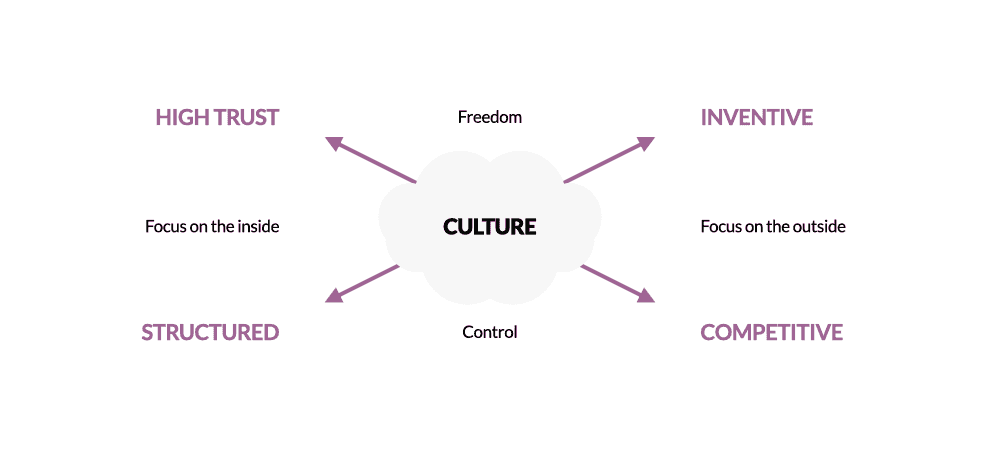
The Competing Values Framework (CVF) is a well-researched, tested, and validated tool. According to CVF, every organization is a mix of four types of culture. Their labels, rephrased to make them more intuitive, are as follows:
- “High Trust” is characterized by mutual trust, loyalty, and respect for the individual (e.g., family startups, nonprofits, or L&D teams).
- “Inventive” is characterized by risk-taking, innovation, and dynamic change (e.g., tech startups or marketing).
- “Competitive” is characterized by competition among coworkers and by market growth (e.g., the stock market or commission-based sales).
- “Structured” is characterized by predictable processes and consistent delivery (e.g., government bureaucracy, car manufacturing, or the military).
These orientations compete for resources, time, and attention like a tug-of-war (see Figure 1). Imagine dividing a resource pool between them. Which ones should be prioritized? Which would not? Handling these competing interests shapes the nature of everything—management and leadership habits, turnover, learning and development, teamwork, service quality, psychological safety, motivation, and compensation design, to name a few.
Figure 1: Cultural Tug-of-War
How to consider competing cultures
Company culture is never straightforward. Initiatives meant to foster change require deft touch and careful steering. Consider the following scenario as an example of opposing cultural forces:
The “Workplace Innovation Program” is a reorganization effort to foster innovation and agility. It does that by flattening the organization and establishing self-managed teams. This is a hard shift toward the Inventive culture orientation, which thrives on autonomy, risk-taking, competitiveness, and dynamism. However, innovation’s opposite (Structured orientation) must be sacrificed to achieve this shift. Stability, control, hierarchy, and quality will all be somewhat deprioritized.
Assuming the leadership team has done comprehensive due diligence to help this program succeed, there is still a built-in cost for these changes. As described above, elements of the organization’s Structured culture may be lost. This can cause managers and employees to feel disoriented, unstable, and frustrated. It also risks attrition and workplace aggression. If these costs become unmanageably high, the organization will face a critical decision: 1) cancel the program or 2) push forward and suffer the implications.
While that dilemma is common to all reorganization and culture change efforts, it will help if change agents and decision-makers are prepared with additional insight. Looking at recently published research in the Journal of the Economic Science Association, thoughtful preparation for cultural decisions comes from studying opportunity cost. That is, one needs to anticipate the give-and-take of culture change. In the example above, that would mean anticipating how an Inventive culture will preclude the organization from aspects of a Structured culture. Stability, control, hierarchy, and quality are the opportunity costs incurred by enacting the hypothetical program above.
Given that additional perspective, facing a go/no-go decision gets reframed as a nuanced balancing problem. The solution may be to pull back on some aspects of the program and reassign those resources to stabilize the company culture. For example, some oversight over the new self-managed teams could be reintroduced.
The research also provides information on how to access those insights. One can increase the awareness of opportunity costs through planned discussion and documentation. That brings these factors to the surface and makes them more visible. What follows are a few tactics to create that visibility. They cover four areas of perspective: 1) culture, 2) resources, 3) objectives, and 4) time. The tactics are scalable, repeatable, and transferable, so they can be used and tailored to fit an organization’s unique needs.
Tactic #1: Make culture visible
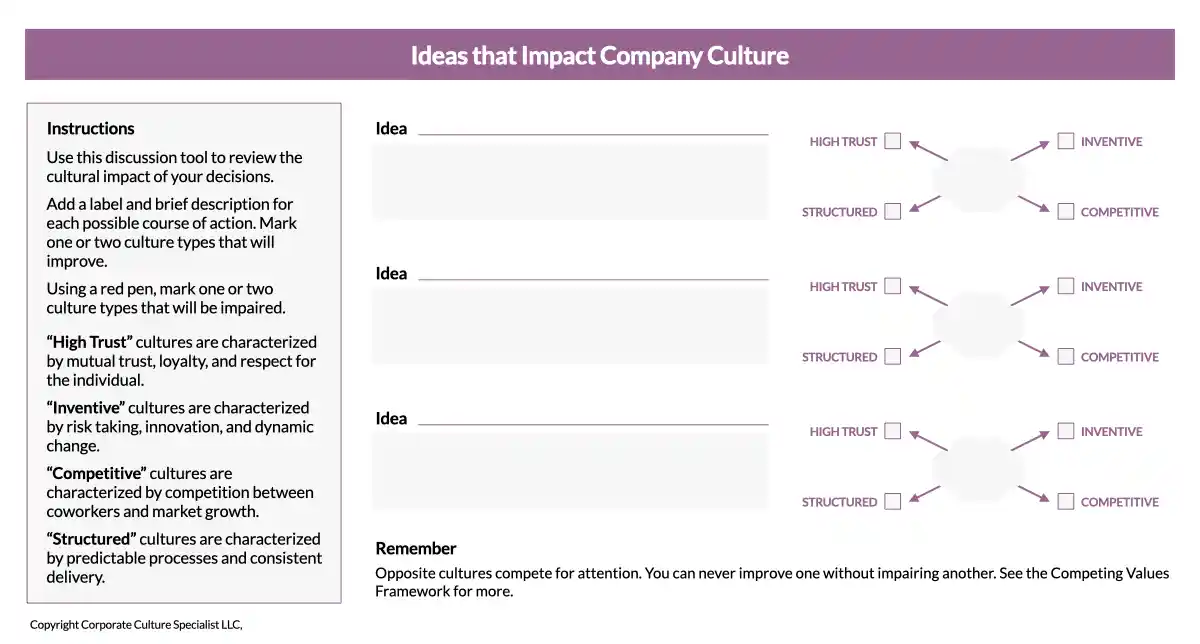
Gather the project team to focus on how each course of action may affect company culture. How would each play out in the “tug-of-war”? Some types of culture will grow but at the expense of their opposites. The assessment can be made using both the CVF framework and the "Ideas that Impact Company Culture" discussion aid below:
Example Ideas
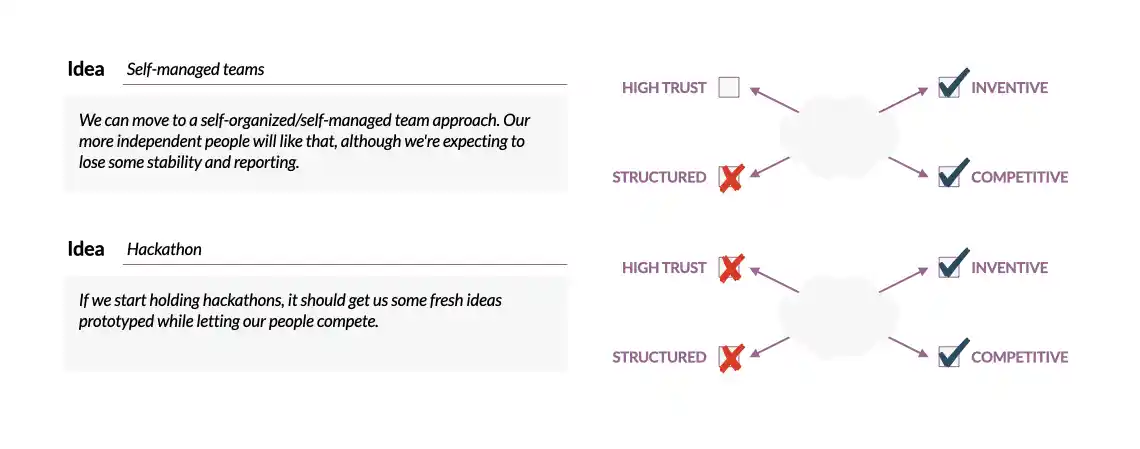
Use the discussion aid to review the most relevant courses of action, then discuss and document your observations. Consider which of the four culture types will increase and which will diminish. For example, the “Workplace Innovation Program” supports an Inventive culture by introducing self-managed teams. As a result, the company culture pulls away from its Structured culture, as depicted in the example above.
Tactic #2: Make resource constraints visible
The next step is for the transformation planning team to construct a “mind map” (see Figure 2 below). Many brainstorming tools can be used for this, such as a whiteboard, Post-It Notes, a flipchart, or Miro. A box labeled “resources” is placed at the center, and participants then write ideas that radiate from it. Associations are followed up to more general ideas. The goal is to identify all available resource categories and examples. In addition to more apparent resources such as funding, overlooked factors like people, morale, space, and time should be included.
Figure 2: Example Resources Mind Map
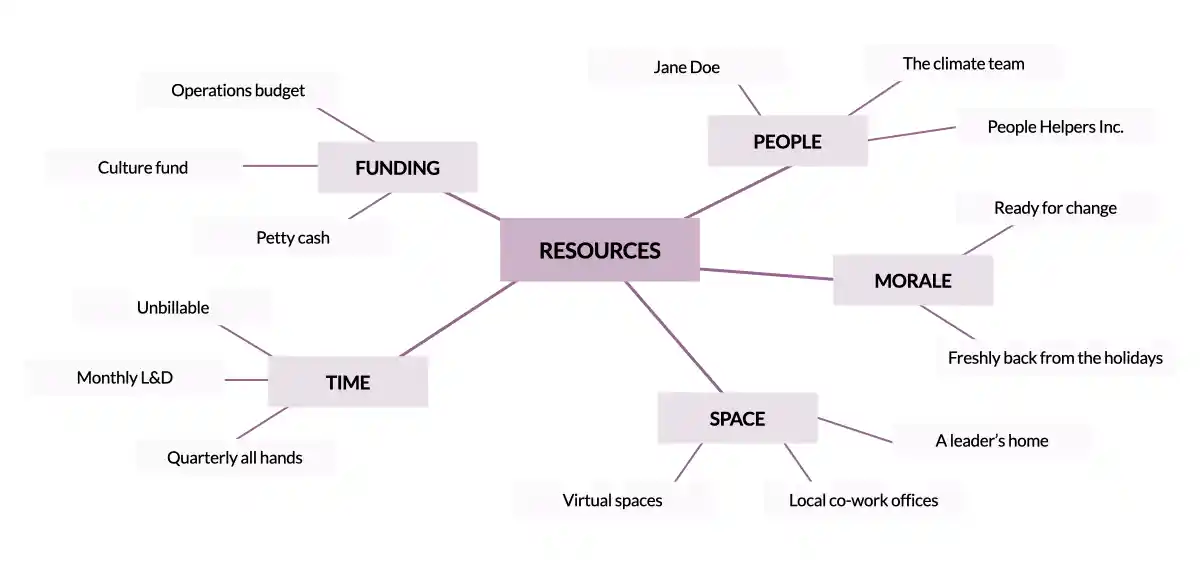
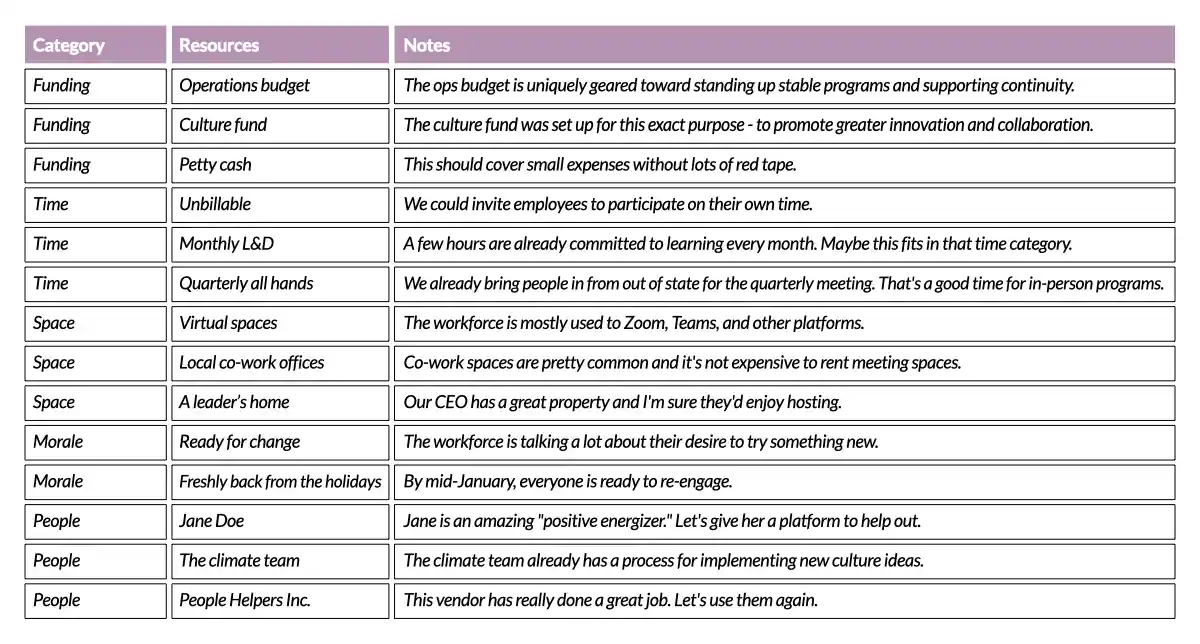
Once comfortable with the completeness of this discovery step, everything on the chart should be compiled into an itemized list (Figure 3). Add additional notes for clarity and file both documents for later reference. Most importantly, these documents should serve as a focal point for discussion throughout the decision-making process. Ensure they remain accessible and up to date over time.
Figure 3: Example Itemized Resource List
Tactic #3: Make objectives visible
The next step is to repeat the mind-mapping and list-making behaviors from Tactic #2, focusing on the organization’s identity and objectives. Write “Our Objectives” at the center of the mind map, then branch out to aspects (or categories) of strategy, organization design, tactics, people management, and anything that helps identify context, guardrails, and direction. Based on the “Workplace Innovation Program” scenario, these example categories and notes might emerge:
- Strategic Identity: we drive novel and profitable ideas to market.
- Design and Alignment: our divisions and teams are designed for agility.
- Service Development: our services are novel, and our empowered teams are dynamic.
- Systems and Process: our environments facilitate transparency and free-flow knowledge.
- Resource Management: we use resources to enable discovery and invention.
- People Management: we hire tech-forward people, compensate competitively, and facilitate self-management.
- Leadership Philosophies: we take risks, are prepared to fail, and celebrate learning.
- Community Bond: our people are bonded by shared risk and exploration.
Tactic #4: Make time visible
This final tactic is an exploration of “time”. Although aspirational, it will enable perspective, a long view, and “good ancestor” choices.
This idea is based on the concept of "tree time," as articulated in The Good Ancestor by Roman Krznaric. It suggests that, just as trees can live for thousands of years, operating in “tree time” places organizational decisions within a longer historical context. Countless decisions have been made leading up to those made today, and countless more will follow. What matters now is serving the long-term wellness of the organization, its families, and its broader community.
To carry out this step, a pause or off-site meeting can be arranged where the project can explore “deep time” and envision the long-term potential of decisions. The team’s thoughts and reflections are collected through any medium that can be stored, shared, and revisited later (such as anecdotes, art, video, etc.). These records are a focal point in the decision-making process, serving as reminders or guideposts for the long-term impacts of choices.
Culture is a core decision-making factor
Company culture is often overlooked and misunderstood, but the choices made in shaping it are central to an organization's character. Further, integrating culture into decision-making processes is undoubtedly a strategic benefit. By acknowledging the nuance of competing values, anticipating the cultural impact of major and minor choices, and building a visible context, organizations develop the capability of a lasting competitive cultural advantage. It creates internal alignment, executes on successful change, and sustains the workforce.

Relevant Practices & Tools
Emerging HR Strategy Practices for Engaging Employees and External Partners Now and Into the Future. >
At its most sophisticated level, HR Strategy defines a future centered around optimizing how employees and their needs are managed and how critical external resources... more »
Developing an Effective Governance Structure that Engages Top Leadership’s Sponsorship and Oversight. >
Every individual in an organization contributes to its culture and is responsible for promoting inclusion and belonging. However, governing bodies hold organizations accountable... more »
Applying Organization Development Principles to Uncover Opportunities for Improving Organizational Performance and Health. >
Organizations are constantly in flux, with multiple change efforts underway. HR is being called upon to facilitate more and more of these endeavors, using Organizational Development tools... more »
Creating a Learning Culture that Supports Career-long Education and Development. >
A learning culture is one that encourages and supports employees’ continuous pursuit of knowledge, sharing of learning with others, and motivation to continuously upgrade their knowledge... more »
The Internal Environmental Scan Tool: Capture and Categorize Factors Internal to the Company Impacting its Objectives. >
This template provides a structure for identifying key internal topics that should be considered in a formal analysis of the business’s upcoming challenges... more »
FAQs
Why do culture initiatives often lose momentum after a strong launch?
Culture efforts often begin with broad enthusiasm but weaken when daily decisions, incentives, and leadership habits continue to reward the old way of working. Employees quickly notice when stated values are not matched by resource allocation, decision rights, or manager behavior. That gap creates skepticism and makes culture work feel symbolic rather than operational. Lasting momentum comes when leaders reinforce the intended culture through their people-management styles and routine trade-off decisions, not just through communications campaigns.
How should managers handle teams that need both creativity and operational discipline?
Most teams do not need a single cultural mode at all times, but they do need clarity about when each mode matters most. Managers should define which work requires experimentation and which tasks require precision, then set different standards for each, rather than applying a single style universally. This reduces confusion and protects both innovation and reliability. The real skill is not choosing one value forever but managing the timing and boundaries between them.
How can organizations avoid turning culture into a branding exercise?
Culture becomes a branding exercise when it is reduced to slogans, posters, or idealized statements that are disconnected from real work conditions. To avoid that, leaders should tie culture discussions to staffing choices, budgeting priorities, workflow design, accountability norms, and customer commitments. Employees judge culture by what gets rewarded, tolerated, and corrected in practice. A culture narrative has value only when it reflects how decisions are made.
How can companies preserve trust while introducing a more competitive or performance-driven culture?
A stronger performance focus does not have to weaken trust, but it will if leaders frame competition as individual survival rather than collective progress. Trust is preserved when performance standards are clear, decision criteria are fair, and support remains available even as expectations rise. Employees are more likely to accept sharper accountability when they believe the system is transparent and not politically driven. Competitive pressure becomes corrosive only when it is detached from respect, clarity, and shared purpose.