
Table of Contents
- The challenges with traditional HR planning and measurement
- Shifting to HR or people-related outcomes
- How to establish the foundations and practice of outcome-based HR
- 1. Strategize and engage top leadership
- 2. Conduct HR value stream workshops
- 3. Access and collect the necessary business and HR data
- 4. Perform analyses to test the strength and impact of the relationships
- 5. Target the most strategically critical and impactful HR-to-business outcome relationships
- 6. Build and communicate a business case to educate and engage managers
- 7. Use the proven drivers of impact as HR KPIs
- Process Metrics have their value and place
- Using outcome-based HR as a foundation for a broader transformation
- Relevant Practices & Tools
Traditional HR strategies focus on people-related processing and outcomes that are too often disparaged by leaders and managers as “soft,” administratively burdensome, or less significant to their meeting primary objectives. The reason is that many quantified HR goals and associated dashboards lack a definitive, widely accepted connection to the business objectives of the leaders whose management efforts they are designed to support. Making HR strategies and initiatives more transparently relevant and aligned with business objectives should be a top priority for those responsible for people and talent analytics. The answer lies in outcome-based HR, which dramatically shifts the focus of HR by planning, setting objectives, managing, and measuring how and where HR adds value by driving or influencing the achievement of business, financial, operational, and talent outcomes.
A focus on outcomes is consistent with the views of business executives and other functional leaders. An oft-cited criticism is that typical HR measurements and reports are inwardly focused on HR policy compliance and disconnected employee trends rather than reporting on the performance of business operations, as Finance, Operations, and Purchasing do. While that concern is largely unfair, given the common reporting and use of business and management (vs. HR) performance metrics such as employee engagement, turnover and retention, safety incidents, pay and benefits spend, and revenue per FTE, it is nonetheless a perception that requires attention and improvement to rest expectations. Outcome-based HR addresses the concerns and significantly drives HR towards clearly business-aligned strategies and objectives.
The challenges with traditional HR planning and measurement
The traditional focus of HR points towards the attraction, development, and retention of talent, which, on the surface, can appear to be outcomes-based. However, how HR measures and reports many of its contributions through its KPIs tells a different story. Despite measuring and tracking meaningful outcomes such as employee engagement, turnover, or succession pool depth and readiness, many other contributions articulated in goals and targeted for improvement initiatives remain focused on the efficiency and effectiveness of their processes. Consider some traditional and time-worn HR metrics and KPIs:
- Cost per hire
- Training hours completed
- Percentage of on-time performance evaluation completions
- Percentage of employees receiving each performance rating (e.g., superior, exceeds expectations, meets expectations, below expectations, and fails to meet expectations)
- Average course participant satisfaction rating
- Hours of learning per FTE
- Percentage of employees with documented individual development plans
The issue is that these are primarily efficiency or compliance-related, not indicators of their effectiveness or value in driving business, financial, or operational outcomes. What matters most to business leaders is not the efficiency of those processes, but rather the outcomes and value they deliver to their businesses. That translates into understanding what is being achieved and the level of value and impact that HR processes, programs, initiatives, and platforms deliver in support of business objectives and resulting outcomes.
What is missing from the focus on and reporting of such metrics is an outcome-based HR focus that identifies issues and designs improvements that make it easier for business leaders to understand the rationale behind HR initiatives and better assist them in achieving their business goals.
Shifting to HR or people-related outcomes
A key improvement opportunity is to shift the focus of HR strategies, goals, initiatives, and measures away from the HR process to outcomes that better and more transparently address the information and decision-support needs of line leadership and management. These relate to changing perspectives by shifting the targeted HR contributions from process-centric to outcome-centric. For example:
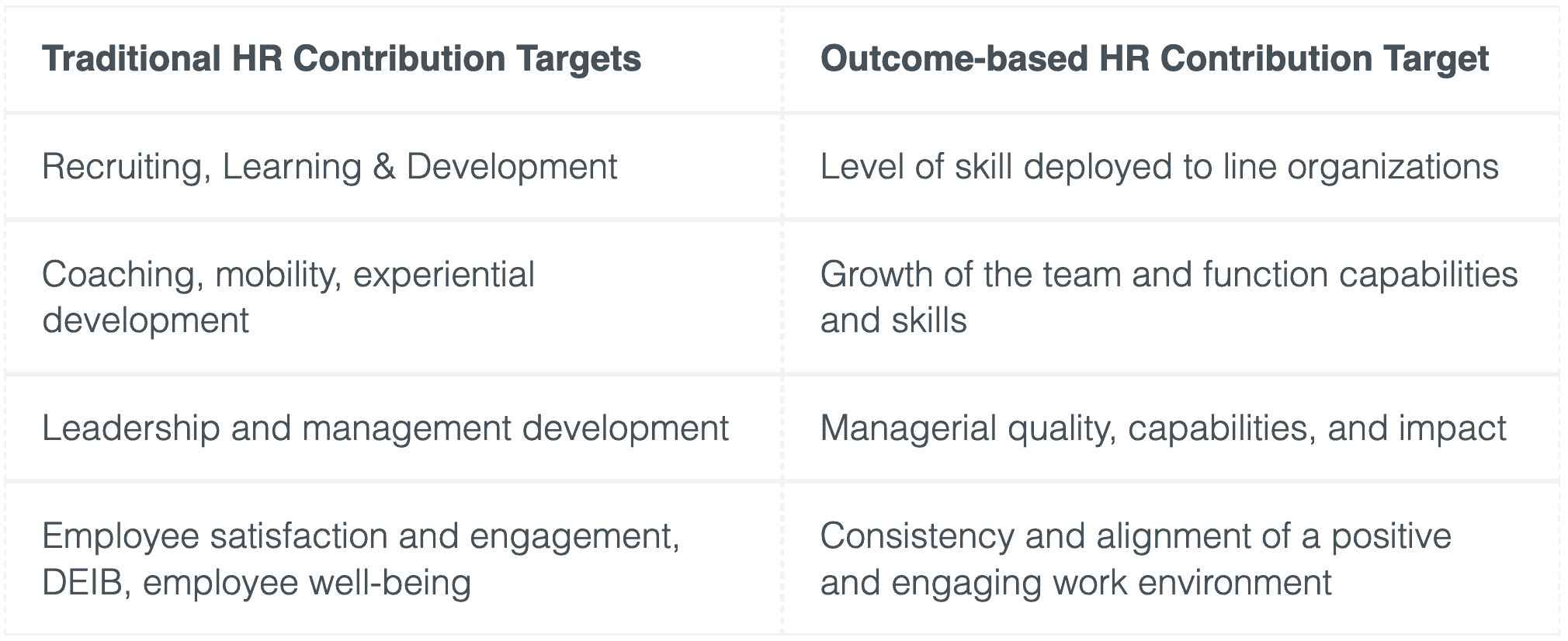
This outcomes-based HR repositioning uses language that more clearly communicates the HR value proposition to line organizations, embedding the purpose of its processes and programs into its plans and initiatives. It goes further by articulating and driving a focus on integrated HR solutions that directly address broader outcomes proven to improve business, financial, and operational performance.
Certain talent outcomes that many HR teams already measure and support the management of represent existing cross-HR function targets that can be promoted as an immediate opportunity to make the shift towards outcome-based HR. While for non-HR leaders some of these may appear difficult to understand as drivers or influencers of business and operational gains, improvement in these indices has a well-established and documented impact on business results in organizational research. They include:
- Employee engagement
- Employee experience (EX)
- Workplace culture
- Organizational agility, change resiliency, collaboration

How to establish the foundations and practice of outcome-based HR
The first step in moving towards HR outcomes as the primary basis for reporting, communicating, decision-making, and action planning is to evaluate the value of those on business, financial, and operational outcome measures as key HR KPIs. The goal is to align HR focus, communication, and actions more closely with the business objectives.
1. Strategize and engage top leadership
Develop plans and generate the buy-in and support needed to shift towards an outcomes-based HR strategy. Create a vision, a clear statement of the business value to be gained, and educate top leaders on how such a move will benefit them, their operations, and their business objectives. Provide examples of how the HR goals and action planning will change for each of their organizations, a timeline for implementation, and how progress will be monitored. Initial changes to key metrics and HR coordination should meet less resistance, as they will likely happen behind the scenes, at a relatively low cost, and be conducted in the service of HR planning and closer alignment with the business and its needs. A governance model with participating leaders from finance, IT, operations, and HR can be chartered to oversee and guide the effort.
2. Conduct HR value stream workshops
Bring HR and business leaders together and conduct workshops that map the theorized or hypothesized downstream relationships between standing HR processes and their presumed talent->business value connections. The output of these sessions is a series of testable relationships that can be further analyzed to validate their impact and extent of influence on business outcomes. Each of the existing HR and talent management processes (e.g., recruiting, onboarding, performance management, leadership development, learning and development) can be evaluated or mapped this way to generate presumed linkages to business outcomes.
Similarly, evaluate the integrated talent-related outcomes (engagement, EX, culture, agility, change resilience, collaboration) and brainstorm the financial, business, and operational outcomes that participants believe can be influenced by them.
3. Access and collect the necessary business and HR data
Testing the HR-to-business value chain requires access to business, financial, and operational data that is normally limited to leaders and analysts in those functions. As a result, a business case and a partnership among HR, Finance, Operations, and IT are needed to gain the required access, which can leverage a governance committee established when engaging top leadership. The outcomes data needed to identify HR-Business relationships can be extensive, so they should initially be limited to a prioritized set of value stream relationships and guided by top leadership’s curiosity and priorities. For example, flat sales might lead them to approve data needed to assess the value stream between hiring quality and skills development with sales growth. In that case, access would be approved only to the business, financial, and operational data or analytics related to that specific assessment. Business outcome data to choose from and request for analyses come from three primary sources:
- Business (market share, brand reputation and loyalty, competitive product and service positioning, customer satisfaction/retention/churn)
- Financial (revenue, earnings, profitability, cash flow, liquidity)
- Operational (sales, production volume, distribution, productivity, innovation, product and service quality or error rates)
Similarly, HR and talent outcome data are required for testing against the business outcomes, and as such should be focused on the outputs of HR processes and efforts, including:
- HR (employee experience, engagement, culture, leadership/management effectiveness, span of control, staffing-to-budget, mobility rate)
- Talent (quality of hire, time to fill, turnover and retention, skill strengths, proficiency level and gaps, replacement pool health, leadership succession pool depth and readiness)
4. Perform analyses to test the strength and impact of the relationships
Further examination of the presumed relationship between the successful (or unsuccessful) performance of the HR process, practice, or activity is needed to generate a more objective evaluation of how much each outcome contributes to (or weakens) the achievement of business outcomes. These analyses can take several forms, depending on the HR team's analytic skills and tools.
The first, or most basic, is a qualitative analysis process that uses basic side-by-side trend comparisons of process efficiency or effectiveness metrics against operational or business outcomes. This requires the most basic analytic capabilities, in which pre-existing HR process metrics (e.g., weekly new hires-to-staffing budget) are plotted over a timeline (weekly, monthly), alongside the operational outcome it is theorized to impact (e.g., department production output level), plotted on the same timeline. This is a non-statistical “covariance” analysis that can be used to visualize a trending relationship without statistical expertise. It can reveal a relationship (sometimes lagging, as with new-hire volumes affecting production levels weeks or months later), but it does NOT confirm that hiring causes increased production.
A second and more robust and valid level of analysis involves using statistical tools (such as Excel, “R”, SPSS, Tableau, or SAS) to perform a quantitative analysis to calculate the impact of HR process or program outcomes on financial, business, or operational achievements. The most basic assessment is the covariance of the relationship to determine the direction (positive vs. negative impact) and magnitude or strength of that impact. That can be performed using a correlation analysis, which, while a stronger and more trustworthy indicator of the relationship, does not indicate that the HR activity causes or partially influences the level of business achievement. On the other hand, the strongest and truest assessment of how much HR process performance impacts the business is through regression testing, which estimates the extent to which the HR process or program outcome impacts business or operational outcomes. There are a number of regression methods suited to this purpose, but one example would be analyzing how much new hires with existing job skill certifications (vs. those without) affect subsequent departmental production output goals, with the regression predicting the probability that those new hires will improve the business outcome.
5. Target the most strategically critical and impactful HR-to-business outcome relationships
Choosing what to report and use as decision-support criteria can be difficult when many options exist. The best guidance is to “measure what matters” to line leaders, since experience suggests that starting by selecting the linkages that focus on the business outcomes that hit their wallets will draw their attention fastest. People manage what matters, so select analytics that leaders and managers care about, and identify how HR can best help them meet their goals to create a win-win relationship. Start small, but focus on a few outcome targets that represent the biggest pain points within the business unit, function, department, or location. For example, a target might include improving sales team productivity through quantified, proven relationships in talent selection, upskilling, and/or retention activities.
6. Build and communicate a business case to educate and engage managers
Once the targeted analysis is complete, communicating its results is essential to gain the line manager’s trust and confidence in its findings, as well as in any follow-on projects, changes, or initiatives designed to improve it. Present the objective data analyses to explain and demonstrate how many of the traditional HR focus areas should now matter to them, as new insights may conflict with their biases against long-standing HR processes. Be prepared to shed new light on the relative (and often combined) value of metrics and topics such as turnover, learning, engagement, culture, and candidate assessment, and on how they drive or otherwise impact production, productivity, quality, revenue, or profitability. Similarly, they should understand how their adoption of managerial behaviors defined in processes and practices (coaching, conflict management, career development, and mobility support) drives improved outcomes for them personally and for the organization more broadly.
7. Use the proven drivers of impact as HR KPIs
Once positive, objectively-based relationships between HR processes, programs, and/or practices have been established, use those as HR outcome KPIs to assess and direct future improvement activities as they rise and fall. Keep in mind that analyses of various HR activities on business outcomes will yield varying results: some processes or programs will show an impact, while others inevitably will not be strongly or sufficiently impactful. However, those that do will act as predictors or early-warning indicators of forthcoming downward business shifts and trends, and HR programs and practices can then be leveraged to address them before they become significant issues. Use these as KPIs to report on, track, and make decisions to continuously enhance and refine HR activity. The key is to communicate their value to business leaders and report to them for regular joint reviews and discussions on resolution or improvement.

Process Metrics have their value and place
An important note about the relative value of traditional HR metrics. Many HR process metrics are useful for managing HR processes by their owners and can be used effectively to drive process efficiencies and employee experience (EX) gains, such as time to process, speed to approval, error rates, escalations, process or step abandonment rates, and user satisfaction. They can also be used to great effect to determine the perceived value to employees and managers (e.g., learning content usefulness and relationship to on-the-job skills development), as well as for total cost or cost-benefit evaluations for total rewards (pay, benefit choices, healthcare cost escalations) and equity or fairness analyses. These also hold tremendous value in process management and improvement efforts (e.g., Lean HR), such as streamlining processes or overseeing and managing HR service-level agreements (SLAs) for response times or accuracy. The measurement and tracking of process efficiency trends are useful, but their value is limited to a specific set of decision-makers and decisions. Reports designed for leadership and managerial use and decision support should focus on outcome-based HR measures.
Using outcome-based HR as a foundation for a broader transformation
The successful shift to an outcome-based HR approach to goal-setting and metrics can be a springboard to a comprehensive transformation of an HR function that is more business-aligned, continuously focused on driving and influencing commercial success, and designed as a primary source of valued partnership across the organization.
The implications of gradually moving towards outcome-based HR can be significant. Using the outcome-focused approach can be conducted in a step-wise evolution that leads to significant changes in how HR plans and measures its contributions, designs solutions, perceives itself, organizes itself, and delivers service. The maturation process can be conducted in a phased approach as follows:
- Identify the linkages between successful and efficient HR processes, programs, policies, and platforms and specific business, financial, and operational successes.
- Update HR measures and KPIs to reflect the outcome-based objectives
- Restructure the HR strategy and set goals aligned with the outcomes that impact business achievement
- Transform the HR delivery model through shared goals, performance metrics, process redesigns, and accountabilities across HR teams and functions
- Establish agile HR deployments of HR staff members across cross-functional project assignments from within their existing structures
- Update the roles and responsibilities of HR employees, with fresh job descriptions, performance standards, development paths and resources, and rewards and recognition. Establish HRBPs and COE leaders as initiative initiators, sponsors, and/or project managers leading integrated HR project teams.
- Reorganize the function around critical talent-to-business impact outcomes, with integrated team make-ups that reflect the skills associated with the HR-related outcomes that continue to show an impact on primary business, financial, and operational goal achievement.

Relevant Practices & Tools
Advanced HR Strategy Practices to Plan for Delivery of Impactful HR Services and Support. >
Advanced HR Strategy is a refined approach to planning long-term HR priorities. It involves increased specificity of plans and goals around key employee groupings and uses detailed workforce data and projections to clarify the needs and trends impacting those groups... more »
Creating an Employee Experience that Bonds High Performers to the Organization. >
The employee experience constitutes the entire journey an employee takes with the organization. This includes everything from pre-hire to post-exit interactions and everything in between... more »
Employing Advanced Stakeholder Engagement Techniques to Reinforce the Criticality of the Targeted Change. >
When done effectively, stakeholder engagement creates trust with the initiative team, generates honest dialogue to build support for the changes, and reduces the potential for conflict... more »
Measuring Talent Outcomes vs. Processes to Increase Business Insights and Impact. >
In emerging practices, the focus shifts from process efficiency (learners per course, cost per hire) and effectiveness (% leaders completing the leadership training program, time to fill) to the business reasons these processes exist—to secure, manage, motivate, and improve workforce capabilities... more »
The Process to Outcomes Translation Tool: Convert HR Strategies and Processes into Representative Metrics. >
The Process to Outcomes Translation tool is designed as a guide to creating metrics that represent HR's impact on the business... more »