
Table of Contents
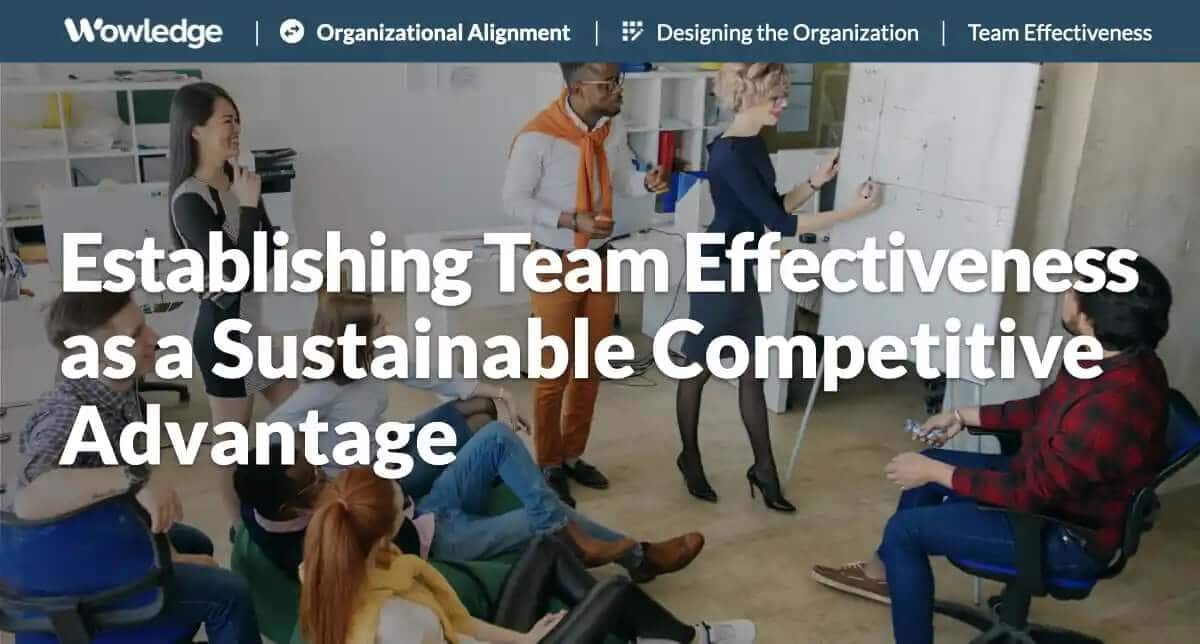
Teams represent the basic building blocks of an organization. They perform the work that produces the organization’s customer, financial, operational, and market value. They provide each employee with a structure for mutual support, assistance, feedback, encouragement, skill, and capability development vital to their engagement and growth, and a sense of identity, belonging, and pride through membership. The combined, coordinated efforts of teams are designed to deliver efficient, effective end-to-end design, development, delivery, and support for a company’s products and services. As such, team effectiveness, with all of its complexities and nuances, is an essential driver of organizational success.
Team effectiveness can be defined as a work group's capacity to collaboratively leverage a mix of skills, experiences, and personalities to achieve shared goals and produce high-quality results. When well-constructed, executed, and managed, it leads to superior business and operational outcomes, higher employee engagement and retention, increased innovation, better client results, and greater agility and adaptability.
How and why team effectiveness is so critical
Team effectiveness has emerged as a critical lever for operational and financial success more than ever. The reasons stem from changes in company operating models and approaches, an appreciation of the value of integrating functional and business-unit work efforts, and a need to respond to heightened sensitivities to volatilities in global markets (financial, geopolitical, supply chain, labor). What is being seen is a significant shift in reliance towards more cross-functional teams and employee networks to better meet changing business requirements, circumstances, issues, customer preferences and perceptions, and shifting market conditions, by acting with greater agility, adaptability, and resourcefulness.
For example, research has demonstrated a rapid growth of team-based work, as evidenced by data showing that 69% of managers work with five or more teams simultaneously. Meetings per employee have increased by 150%, and the time managers and employees spend on collaborative activities has increased by 50%.
At the same time, the nature of teams is changing. Consider the shifts in team makeup and membership that are impacted by:
- The geographic dispersion of employees and worker resources has increased with offshoring, reshoring of operations and staffing in lower-cost locations, and outsourcing of supply chain, employee, or customer support, and administrative (i.e., shared services) functions. All of these are occurring despite the widespread post-pandemic return-to-office initiatives.
- Corporate resizing and reorganizing activities are disrupting employee work relationships and networks, raising questions such as “Who is responsible for which task on my team?” “Who are my process (input and output partners and associates?”, and “To whom do I report (direct and indirect managers)?”
- Technology adoption rates are exploding as the expansion of automation and introduction of AI change roles and responsibilities, work processes, and team or work unit skill requirements.
- How employees collaborate is shifting from direct (meeting, hallway, and shared office communications) to increasingly indirect (online collaboration, sharing, and project and process management platforms).
- Team stability is lessened by higher rates of turnover (voluntary and involuntary), low engagement levels, and generational shifts in employment expectations and needs.
The impact of those changes is altering how teams are formed, staffed, and managed, with their performance and productivity at significant risk. Consider how they create difficulties in establishing, building, and maintaining coordination, as well as intra- and inter-team trust and confidence, which are essential building blocks of successful team performance. Think about how changing faces and roles within a single team can disrupt the collaboration and support that is required to drive process and product/service improvements and innovations. The impact on the managers of those teams, who are pressured to drive sustained team performance and goal achievement despite more complexity and variability in their and the team’s requirements.
Performance data as a business case for targeting team effectiveness
High-performing teams have been shown to deliver not only operational value but also business and highly beneficial talent outcomes. Consider, for example, that Gallup found that, across almost 184,000 teams, those in the top quartile achieved 18% higher sales productivity, 14% higher production, 18% higher performance, and 23% higher profitability. At the same time, those teams achieved 23% higher employee engagement, which is associated with 81% lower absenteeism and 43% lower turnover.
Similarly, recent team effectiveness research by Deloitte demonstrated that high-performance teams are more than twice (2X+) more agile and resilient in the face of adversity, setbacks, and not surprisingly report that they are quicker to respond to business and operational challenges and are able to make decisions and take action more quickly than their lower-performing team peers. Interestingly, they are also more than 15% more ready and likely to adopt emerging AI technologies and to generate results and impacts from their use. The latter point provides evidence that highly effective teams are more innovative and better able to adapt to new requirements and adopt advanced capabilities.
However, other studies have found that as many as 75% of cross-functional teams underperform on key measures related to their purpose and primary objectives. The reasons appear to be a result of failure to achieve at least three of the five criteria identified for their success:
- Meeting the allocated budget
- Staying on schedule
- Adhering to project specifications
- Meeting customer expectations
- Maintaining alignment with the company’s corporate goals
The root causes of these team effectiveness shortcomings include: 1) unclear governance and oversight, 2) a lack of team and individual member accountabilities, 3) working towards unclear or generic goals, and 4) a failure by leadership to prioritize their success.
Seasoned HR and business leaders will recognize these as common symptoms of failed development and improvement initiatives in companies of all sizes and maturity levels across industries. It is all too common for team effectiveness to be expected as a natural outcome of appointing great managers and leaders, assigning the “best and brightest” employees to the team(s), creating a grand vision and ambitious goals, and providing a healthy operating budget. However, as will become clear, while some factors are helpful, they are not sufficient to create a successful and effective team.

Understanding team dynamics and how effectiveness is established and sustained
Popular Models
A number of team effectiveness models have been used as the basis for team formation, management, and improvement over the years, with varying levels of testing and proof of their actual value in driving performance. As the concept of teamwork involves humans operating under an apparently infinite set of internal and external factors that influence how people will act, react, comply, or defy, adapt, or resist, any model should be approached and used with caution. The reason lies in the range of considerations and factors that each targets for building and maintaining high-performing teams, which can vary considerably. That said, some popular models include:
- Tuckman Model. Identifies five stages of team development and maturation (Forming, Storming, Norming, Performing, Adjourning) to help understand and manage group dynamics, conflict resolution, and productivity at each stage.
- 7 C’s of Team Effectiveness. Salas and Tannenbaum identified seven essential drivers of team effectiveness (Capability, Cooperation, Coordination, Communication, Cognition, Coaching, and Conditions) that encompass the full range of capabilities, behaviors, activities, and structures needed to create and manage sustainable team success.
- Lencioni Five Dysfunctions Model. Offers a unique and popular take on why teams fail (Absence of Trust, Fear of Conflict, Lack of Commitment, Avoidance of Accountability, and Inattention to Results) and has long been valued for its use as an assessment and intervention design.
- Belbin Team Roles Model. Defines nine (9) distinct roles that team members can play to create balance and enhance coordinated and collaborative team performance. They are structured to work as an interlocking puzzle of skill and capability pieces that cover the strategic, operational, and human elements needed to run a successful organization.
- Hackman’s Five Conditions Model. The model's uniqueness lies in its focus on the antecedents of team success, from which successful team performance will flow. The five factors (Real Team, Compelling Direction, Enabling Structure, Supportive Context, and Expert Coaching).
These can be used as a starting point, but more recent research on the drivers of team effectiveness, excellence, and success helps build a better understanding of the factors that influence and predict high-performing teams.
Recent organizational research
A few compelling, large-scale studies have produced robust findings about the nature of high-performing teams, what sets them apart from many others, and the lessons organizations can apply in the creation, management, and refinement of team structures, standards, and development.
McKinsey argues that, despite assumptions that managerial skill and team chemistry are the primary drivers of team performance, those oversimplify the equation. In fact, it identified 17 critical “team health” drivers, which it boiled down into four categories:
- Configuration. The team has clearly defined roles and a mix of diverse experiences and perspectives.
- Alignment. Team members are clear and aligned on the team’s purpose and goals, and are committed to them.
- Execution. How the team members conduct the work in unison with agreed-upon, aligned norms around communication, decision-making, feedback, support, and coordination.
- Renewal. Culture and behavior standards related to belonging, conflict management, innovation, recognition, psychological safety, and trust.
Effective teams average high ratings on at least 11 of the 17 behaviors across the categories, indicating that perfection is not required to drive team effectiveness. At the same time, excellence in just four factors—trust, communication, innovative thinking, and decision-making—should be prioritized, as they have been shown to have the greatest impact on excellence. In fact, when viewed collectively, those factors account for between 69%-76% of the differences between low- and high-performing teams when it comes to three key outcomes: efficiency (productivity and timeliness); results (delivers on objectives and delights stakeholders and customers), and innovation (creative solutions that add critical, long-term organizational value).
Equally interesting are the findings that high scores on “trust” lead to over three times (3.3X) the likelihood of greater team efficiency and over five times (5.1X) the likelihood of achieving the desired performance results.
University of Connecticut business school professors conducted a highly informative “meta-analysis” of results from over 150 team effectiveness studies and discovered correlational trends that offer insights into factors influencing team effectiveness. The findings suggest that 24 factors can be roughly summarized as relating to: structure (e.g., roles, authority, task scope and complexity, interdependence, technology), culture (trust, creativity, cohesion, conflict, psychological safety, decision making, information sharing), and capabilities (skill, abilities, demographic/functional/personality diversity, turnover).
Results indicate that the biggest contributions to team performance outcomes are driven by:
- Prioritizing team objectives, harmony, and interdependence
- Breadth and depth of team cognitive abilities
- Psychological safety
- Task focus and commitment
- Task and goal interdependence
- Team member empowerment (twice the impact of other factors)
Other important drivers related to high team cohesion and process workflow include:
- Cooperation during discussion
- Learning orientation
- Supportive work context
- High-performance and constructive managerial practices
Deloitte Consulting surveyed over 1400 high-performing team managers and employees across U.S. industries and found that certain practices and conditions were associated with significantly higher team performance. What it found was that, despite trends towards the adoption of disruptive technologies, teams' ability to excel is deeply rooted in interpersonal capabilities and behaviors. Findings include that high-performing teams, compared to their lower-performing counterparts, are:
- Over twice (2.4X) more likely to say their team members respect each other
- 1.3X more likely to ensure that everyone feels included
- 2.3X more likely to trust each other
- 2.5X more likely that their team strongly supports and encourages others
- 2-2.5X more likely to have a strong learning culture
Perhaps of greater consequence are the operational and business outcome-impacting outcomes of high team effectiveness:
- 16% higher resilience and ability to handle changes and respond to challenges
- 19% more likely to practice divergent, creative, and innovative thinking
The research indicates that driving sustainably high team effectiveness is a complex mix of elements related to how the team is comprised, assigned, aligned, coordinated, and managed at the mission/purpose, goal, and behavioral levels. With so many elements to integrate and so many teams to monitor and manage, the challenges are substantial for business and HR leaders alike.

Impactful approaches to addressing and enhancing team effectiveness
As indications of team performance issues or shortcomings emerge, HR leaders should consult with business or operations leaders to identify the causes and potential solutions to help the team make necessary corrections. There are many reasons why teams fall short of their goals, and an equal number of potential pathways to improvement. As research has shown, the causes most often stem from poorly aligned goals, unclear accountabilities, poor intra-team coordination, a lack of necessary skills and capabilities, and insufficient trust and commitment.
As such, while the most common team effectiveness interventions often take the form of people- and interpersonal-related fixes, work processes and structures often require adjustment. As a result, a number of HR and process-improvement methods are traditionally used to address substandard performance and outputs among teams. An academic meta-analysis demonstrated the usefulness of many of these techniques for improving team effectiveness.
1. Structured issue and solution identification
Given the range of possible reasons for team underperformance, every effort to improve their effectiveness must start with an objective, data-driven understanding of the root causes of the team performance problems. Organizational development and performance consulting processes are proven methodologies for not only determining the reasons but also identifying the most direct and lasting solutions. Similarly, evidence-based HR approaches are used to more objectively and effectively identify the “true” reasons for performance shortfalls and to develop targeted solutions that address their root cause(s).
2. Team charter development
Commonly used at the start-up of a new team, this activity is equally powerful for reestablishing and reorienting a team’s purpose, goals, norms, accountabilities, and processes. The critical outcome is agreement and alignment among team members and leaders regarding their shared mission, values, practices, priorities, and goals. Team-based goal and project planning activities are equally impactful, particularly when used to determine and distribute task and role responsibilities.
3. Team building
Despite the impression of many that these sessions and events are designed as “fun” activities targeting team unity and cohesion, the most effective of these create transparency and openness within the team, and oftentimes topics that are related to how they manage disagreements, deal with errors or failure, improve workflows, and the meeting of intrateam goals and schedules. Their effectiveness is greatest as team members learn to communicate, collaborate, listen, and act with respect, and to coordinate their activities as the team matures.
4. Team training and coaching
Group skills and capabilities development can generate substantial returns in team effectiveness, as learning with peers creates a common language, tool sets, and approaches that team members can use to better learn from, reinforce, and support one another as they apply lessons and methods on the job. Similarly, group coaching can help generate team alignment to address common challenges and skills gaps, and build team cohesion through shared learning experiences.
5. After-action reviews
Formal team reviews or debriefs after the completion of a work effort, project, or performance period (e.g., shift, production run, fiscal quarter, or special project) have been demonstrated to be powerful mechanisms for reviewing how a team functions, responds to normal or unusual circumstances, and succeeds or fails. As used in the military, these are designed to facilitate team learning and improve its future performance without assigning blame. The team is asked to state and evaluate what was expected, what actually occurred, why it occurred, and what can be done better in the future.
6. Work style and personality assessments
These are popular for increasing within-team understanding of each member, and for processing how each member performs their work, processes information, communicates, prefers to receive direction and feedback, and contributes to generating a better understanding of each employee’s (own) and others' strengths, preferences, core values, and gaps. Tools such as the DISC, Myers-Briggs Type Indicator, and the Hogan Team Report are used for formal assessments and feedback.
7. Process improvement
Team effectiveness is often a function of how the workflow is designed, with unseen inefficiencies related to how task responsibilities are distributed, decisions and hand-offs have unclear accountabilities and timeframes, and required approvals are assigned to a single individual who becomes a bottleneck. As such, engaging team members directly in assessing and redesigning their workflows can be a powerful approach to improvement, garnering high, often immediate levels of employee awareness, acceptance, and adoption. Formal, structured methodologies such as Lean, Agile, and Six Sigma have been shown to improve team efficiency, effectiveness, and impact.
8. Team self-reliance
When teams have clear, specific goals, clear responsibilities, shared accountabilities, agreement on their values and behaviors, and a commitment to the team’s success, great work output and value will follow. Those effects can be amplified by designing their jobs to provide them with autonomy or decision-making authority over how and when they perform it. Assign a level of independence that is appropriate to each individual’s capabilities and expertise, and directly aligned with the generation of customer and partner value. Provide regular opportunities for team members to share feedback, input, and ideas on team operating improvements, empowering them to review, assess opportunities, and act on solutions, small or large.
9. Team performance and health measurement
People and work process analytics provide essential insights into team effectiveness, covering production volume, quality, timeliness, and productivity, as well as individual performance and contributions. Team health and well-being are equally important, as many human-based issues, such as stress, physical and psychological well-being, employee engagement, and managerial effectiveness, can drag down team performance. Use employee listening methods to track sentiment and potential issues. Leverage quantitative data such as absenteeism, turnover, sick leave/PTO, and medical and psychological health benefits utilization rates as early warning signs of pending team effectiveness issues.

Relevant Practices & Tools
Core Organizational Design Practices To Align The Organization With Business Strategy. >
Organizational design includes activities to outline and implement an organization that can enable the pursuit of the business strategy and organizational goals... more »
Applying Organization Development Principles to Uncover Opportunities for Improving Organizational Performance and Health. >
Organizations are constantly in flux, with multiple change efforts underway. HR is being called upon to facilitate more and more of these endeavors, using Organizational Development tools, methodologies, and frameworks... more »
Conducting Performance Consulting-based Learning Needs Assessments for Specialized Solutions. >
“Performance Consulting” addresses workplace performance issues through a structured approach to understanding and resolving them... more »
Creating Group Coaching and Mentoring Programs to Broaden and Syndicate the Potential for Impact. >
As a coaching and mentoring culture progresses, its effect is felt throughout the organization. The key at this level is to syndicate the use of coaching and mentoring deeper into the ranks... more »
The Team Assessment Tool: Evaluate an Executive's Current Team to Identify Strengths and Gaps to Focus on. >
A template used to facilitate assessing each direct team member on several variables, including performance, relationship, energy, type of thinker, and potential exit risk... more »