
Table of Contents
- Understanding the consumer goods industry
- Primary industry characteristics and priorities
- Current consumer goods industry challenges
- Important industry trends relevant to consumer goods HR teams
- Consumer goods HR challenges and issues
- Priority talent strategies solutions for consumer goods HR teams
- Relevant Practices & Tools
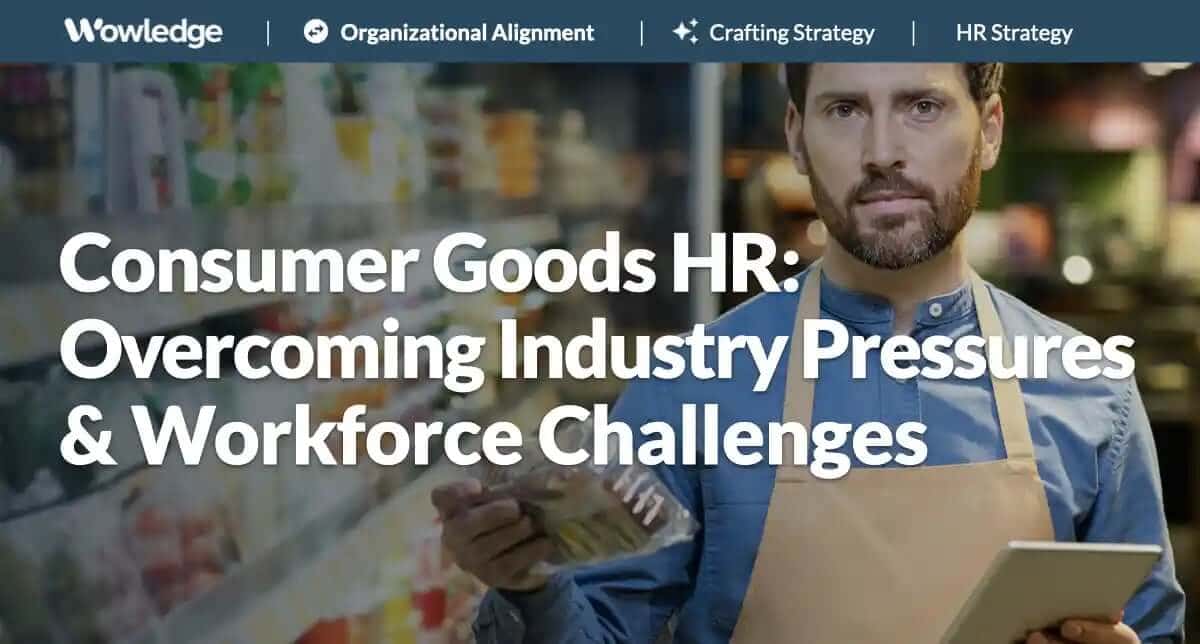
The consumer goods industry, also referred to as consumer products or consumer packaged goods (CPG), develops, manufactures, and markets everyday physical items for individual use, such as food, beverages, toiletries, household supplies, clothing, appliances, and automobiles. The industry is foundational to the global economy, with consumer spending on the goods it produces a primary component of global gross domestic product (GDP) calculations. It is also a major driver and component of the success of other operations, including retail, e-commerce, and supply chains. As the U.S. Consumer Brands Association reports, not only does it contribute $2.5 trillion annually to the U.S. economy (10% of national GDP), but it also employs and supports over 22 million jobs, making it the country’s largest manufacturing employer. Given its reach and impact, the role of consumer goods HR teams in its success is essential to continued growth and adaptation to changing market dynamics and consumer appetites.
Consumer goods HR teams face increasing complexities as they support their organization’s responsiveness to the ever-shifting financial conditions and consumer behaviors. They are called upon to create and manage processes, programs, and practices that address a diverse range of employees, from product development to distribution, finance to manufacturing, and customer analytics to supply chain, across geographic, national, and cultural boundaries. Given the fact that these companies influence and drive consumer spending, which is the primary engine of economic growth, consumer goods HR professionals have unique opportunities to improve not just the lives of their company’s customers, but also the well-being of the communities they serve.
Understanding the consumer goods industry
The industry generally focuses on sales to individual consumers or households, although many of the products are purchased and used by businesses. It is generally divided into two segments, defined by the expected lifespan of the associated products. In turn, the operations of those segments are influenced and driven by a combination of factors that emphasize and stress certain corporate functions to respond and deliver products that targeted consumers are motivated to buy.
- Non-durables: These are products designed to last and be consumed over a shorter period (typically within three years), purchased and repurchased or replenished frequently, and often priced at a lower per-unit cost than other goods. These include items that are considered “staples” or basic necessities of modern living. Examples include groceries, personal care products, household supplies, and clothing items.
- Durables: These are more expensive, long-lasting products designed for repeated use and continued ownership measured in years, and are thus purchased less frequently. They represent more significant investments for consumers and are often designed with a range of increasing quality, capability/functionality, and luxury. These are often considered consumer discretionary purchases, as many of the products are repairable and upgradable, allowing consumers to accelerate or delay their replacement, which often occurs as economic conditions improve or erode. Examples include cars and trucks, appliances, electronics, home furnishings, sporting goods, and luxury items such as jewelry.
Primary industry characteristics and priorities
The consumer goods industry is characterized by a range of factors and activities that create both challenges and opportunities for its companies. The first is its dual nature in consumer purchasing patterns—cycle-driven vs. consistent demand. Certain conditions drive purchasing cycles, such as economic (financial, labor market) conditions, seasonality (holidays, warm vs. cold weather), and new and innovative product releases (technology products, clothing styles). Other patterns, such as those typically associated with non-durable staples, tend to be purchased on a more or less consistent basis.
The second is the major focus on brand awareness and product marketing that is required to gain potential (and maintain existing) customers’ attention and “share of wallet” to drive revenue, customer loyalty, and market penetration. Unlike in business-to-business marketing, consumer spending is often measured in individual sales of single or small units, with lower margins, against many competing products. Advertising and “hype” are needed to differentiate products, build positive brand reputations, and motivate product purchases.
Other primary characteristics include a focus on manufacturing efficiency and reliability, as the speed and adaptability of production lines are often as important as the quality and quantity of output. As products are added, updated, or upgraded, rapid changes in manufacturing, tooling, process flows, and staffing are required to meet production schedules aligned with product availability and placement requirements. Seasonality, first-to-market, and consumer-driven requirements dictate timelines that manufacturing and production teams must adhere to. That is related to the pressures to generate sufficient supply chain volumes, speed, and efficiency necessary to achieve the economies of scale needed for cost-effective product distribution, while maintaining sufficient inventories in each market served to sell the company's products at scale.
Current consumer goods industry challenges
A number of issues are facing companies in this industry that are creating pressures they must address. An awareness of these is needed not only by top business and operations leaders but also by consumer goods HR leaders and teams whose roles require meaningful responses and support from the perspectives of culture, talent, leadership development, and coaching.
- Consumer price increases: Volatility in the current economic environment is prompting consumers to reconsider what to buy and when. McKinsey reports that only 35% of U.S. consumers are optimistic about the economy, with the largest declines among high- and middle-income households. 52% of consumers cited rising prices as their top concern, with 25% naming “making ends meet” as their #2 concern. The fallout is projected to negatively impact discretionary spending by as much as 40% on both durables and non-durables, such as home improvement and decor, sporting goods, and apparel
- Eroding consumer sentiment: Consumers are increasingly concerned about the product value-to-price equation due to both economic conditions and perceptions of industry product decisions (e.g., smaller portions, lower quality). In fact, Deloitte reports that 47% of global consumers, including 35% of high-income households, are now "value seekers" actively demanding greater value received for the price of the goods they are considering.
- Geopolitical trade policies: Nationalistic trade policies are forcing price increases, individual market resets, and the need to consider changes in product mixes and price points. These are pressuring companies to make product decisions not only based on cultural preferences and tastes but also on local value-to-price sensitivity. In some cases, the consumer products no longer make sense to offer in certain countries and markets. Amid inflationary pressures, consumer prices continue to rise.
- Investor pressures on cost management: Financial stakeholders are increasingly voicing concerns and pressuring companies to achieve substantial improvements in operating expenses and efficiency, according to Deloitte. 51% of surveyed consumer goods companies report focusing on efforts to lower costs and improve productivity. This is being driven by total shareholder returns and margins dropping by more than 50%. The need to go beyond workforce reductions as a cost-reduction strategy has become prevalent, with 76% of companies in the industry focused on digital transformation (including the adoption of AI technologies) to achieve a lower expense profile.

Important industry trends relevant to consumer goods HR teams
Expanding use of technology
An increased reliance on and broader applications of advanced technologies are creating the need for more talent to develop internal capabilities related to consumer engagement and participation, including feedback on products and purchasing preferences, as well as data on shopping behavior. The rapid adoption of AI-related technologies has led to the automation of work processes, some of which are fully automated (and even autonomous). Yet Bain reports that only 37% of industry executives list this as a top strategic priority, compared with 84% of executives in other non-tech industries. At the same time, Deloitte reports that 92% of surveyed industry executives have plans to deploy AI agents and autonomous systems in the immediate future.
Generative AI (GenAI) applications are being reported in product development, hyper-personalized marketing, and supply chain streamlining. Further use of technologies involves increased deployment of “Direct-to-Consumer” (D2C) channels, quick delivery, and convenient pickup and return locations. Consumer goods HR and L&D teams need to expand education and application experiences focused on developing skills in these areas.
Changing retailer relationships
Retailers are moving from pure consumer goods sales outlets (partners) to competitors, as they pursue more private-label goods to sell in their stores (physical and digital). These can be offered to customers at lower price points while generating higher sales margins. White-label products are increasingly valuable to many retailers. In fact, Deloitte reports that 88% of surveyed retail executives are actively seeking partnerships, while 86% state that these partnership-generated products increase sales at their outlets. Having leaders who are skilled, competent, and motivated to build and manage external networks becomes a critical capability that consumer goods HR teams need to develop. At the same time, learning how to work and coordinate more extensively and effectively with external partners requires skill development for middle managers and their teams.
Increasingly dispersed supply chains
Geopolitics and climate events have driven companies away from globally distributed and optimized supply chains towards smaller, more localized and tailored supply and distribution channels that are more agile, responsive, and designed to avoid trade policy disruptions. These also offer the opportunity to more closely align with, familiarize, and embed operations and employees in local tastes and preferences, leading to greater personalization of products and product mixes. The reshoring of manufacturing and distribution channels is a related trend that, when combined with localization, makes employee and contractor language and cultural proficiencies critical skills and capabilities that consumer goods HR leaders must address. Having the right people (employees and contractors) with the appropriate knowledge, expertise, and skill sets available and assigned to each market(s)is an essential shift for TA teams.
Outsourcing of core corporate functions
In search of greater cost efficiency and to free internal resources to focus on strategic market, financial, and operational processes and objectives, Deloitte reports that 59% of industry executives plan to outsource core functions or establish internal centers of excellence (COEs). The direct impact of such moves on the operating model and organization design is a strategically critical issue for consumer goods HR leaders, one they are uniquely positioned to address. Anticipating such shifts and being prepared to facilitate and support decision-making on staffing levels and associated skill mixes, as well as repositioning organizational responsibilities, become essential HR capabilities.
Consumer goods HR challenges and issues
Consumer goods HR teams and the leaders they support face talent challenges that require equal parts of resourcefulness, creativity, and adaptability. The primary challenge arises from the range of operations and roles typically employed, as well as the pressure to produce high-quality products tailored to multiple consumer groups and markets. The complexities increase exponentially when considering that these must be designed, tested, and produced in sufficient volumes on irregular schedules, and distributed through hundreds of retailers and online platforms across thousands of locations. The need for properly skilled and well-prepared employees working in fully staffed operations, with reliable, repeatable processes that combine to deliver goods to market in a timely and complete fashion, is a significant undertaking.
The primary barriers and challenges to success that consumer goods HR and leaders face include:
Wide range of skills employed
Consider how companies in the industry have traditionally fielded a comprehensive set of capabilities spanning the entire value chain, spanning product design and development, manufacturing, marketing and brand management, financial and revenue management, institutional sales, supply chain (raw materials procurement, inventory, shipping and distribution), quality and customer support, as well as HR, IT, Security, and Legal. The mix of large employee populations whose roles require highly strategic, creative, analytical, and/or physical capabilities can make one-size-fits-all HR policies, practices, and programs substantially insufficient. The complexities of managing human resources further complicate the organization and coordination of teams in the environment where the products are created and sold.
Talent shortages
Across the range of roles employed in the industry, global talent shortages make the proper staffing of operations a significant issue. The Association for Packaging and Processing Technologies says that 95% of consumer goods companies are struggling to hire skilled operators, technicians, and logistics coordinators due to turnover, retirements, and heavy competition for skilled workers. And the operational cost of those is high, as research by Manpower found that 89% of manufacturers are experiencing productivity losses tied to staffing and skills gaps.
At the same time, the competition for data and digital experts, especially those skilled in software, AI, and data science, which the industry is increasingly reliant upon, is being waged against leading technology and other industry leaders. Issues surrounding less-competitive wages and not being seen as attractive alternatives to many big-name companies are plaguing many companies. At the same time, there is a sense that consumer goods companies continue to prioritize consumer goods or retail industry experience in recruiting efforts over digital-first or e-commerce skills and experiences that are more valuable in the long run.
High employee turnover and burnout
Given that companies need to meet irregular product design, development, manufacturing, and distribution schedules and volumes due to seasonality, competitively driven product upgrades and introductions, and shifting consumer purchasing demands, the irregularity and pressure on workers can be substantial. As a result, turnover can range from 7-8% in corporate functions to as much as 40% for manufacturing, inventory, and distribution workers due to the physical and inflexible nature of their work. Talent pipeline shortages are being reported not only in the US, but even more severely in key growth and emerging markets of Asia and South America.
Managing geographically-dispersed employee bases
The largest consumer goods companies have operations in almost every continent, with some operating in 150 to 180 countries. With a combination of production facilities and distribution networks that deliver goods to large retailers in major cities and tiny shops in remote rural locations, the complexities of managing those workforce segments to meet consistent standards for quality, quantity, and timeliness are many. Consumer goods HR teams are required to develop policies, processes, development, and total rewards programs that are tailored to local cultural expectations, legal and regulatory standards, language and dialects, and company-defined profitability requirements.
Developing digital transformation skills
With the industry’s rapid adoption of automation, AI, and e-commerce, consumer goods HRT teams are under pressure to coordinate with relevant functions to source and hire digitally skilled workers, while delivering the training and development needed to upskill them to adapt to new tools, processes, and methods. requires a workforce that can adapt. The breadth and depth of these adoptions require strategic responses to prepare different segments of the workforce to accept and adopt such changes in how they perform their jobs.
Leadership readiness and succession
Turnover and burnout are impacting the leadership and management ranks as much as in the individual contributor ranks. The pressures of responding to continually changing business circumstances and managing internal responses to them can be overwhelming, underscoring the need to better prepare leaders to adapt and step up. With leadership transition failure rates estimated at 25-50% in the first 18-24 months, consumer goods HR teams need better assessment tools, more effective development pathways, and comprehensive, robust transition support ecosystems to drive higher levels of managerial and leadership success.

Priority talent strategies solutions for consumer goods HR teams
The range of possible solutions to HR challenges in the consumer goods industry is as broad as the barriers and challenges being faced. What is essential is to evaluate the degree of “pain” being experienced relative to the impact that any problem area has on critical business, financial, and operational outcomes. That said, responses and initiatives that better prepare the organization to effectively handle the volatility inherent in the environment should take precedence.
1. Build agile leadership
Resilience and change start at the top, and making adaptive leadership a high-priority core competency model for leaders and managers is a powerful starting point. The model supports the development of leaders who are capable under fire, can lead their teams through chaos and change, and can more effectively handle the stress and anxieties that come from working in volatile environments.
2. Establish a nimbler culture
Consumer goods HR leaders should explore opportunities to establish a more agile and adaptable culture that enables more responsiveness to shifts in market conditions and consumer preferences. Deloitte reports that 89% of companies in the industry recognize the need to develop a culture of speed and agility to accelerate innovation, product differentiation, and responsiveness to changing customer tastes and preferences.
Embed organization-level change management capabilities and routines, and more frequent and transparent communications that keep employees informed and aware of trends, challenges, and organizational direction. Encourage and support a culture of collaboration and continuous learning across business units and functional boundaries, as those are proven drivers of significantly higher levels of innovation.
3. Embrace continuous learning and upskilling
The rapid evolution and adoption of advanced digital technologies are creating an enormous demand for developing employees who are capable of working with and adapting to changing workflows. The use of an integrated skills-based approach across HR programs and processes enables a more detailed and refined view of individual, team, function, and enterprise skill sets. Adopting a skills-based employee development approach enables more efficient development of learning paths, as the new skills employees need across functions, professions, and businesses can be developed and delivered more cost-effectively. As consumer goods HR L&D teams understand, the in-demand topics related to designing, implementing, and co-working with AI, robotics, advanced analytics, and the internet of things (IoT) are just the beginning. Those need to be supplemented with associated skills education and development opportunities in advanced team collaboration, communication, critical thinking, and emotional intelligence (EI).
4. Reconsider the organizational structure
Organization design is increasingly evolving, with the deployment of agile team structures, reorganizations that bring internal value stream partners (e.g., product development and manufacturing) closer together, and widespread chartering of cross-functional design and improvement projects. The use of organizational network analysis (ONA) is particularly powerful for exposing informal employee networks that drive innovation, revealing skill deficits, and identifying potentially more effective management and team structures. Equally important is the need to redesign the organization to optimize collaborations with external outsourcing, contracting, and service companies.
Relevant Practices & Tools
Core HR Practices to Activate the Digital Transformation Journey. >
Digital transformation integrates digital tools, technology, and culture into all aspects of a business, fundamentally altering how an organization operates and delivers value to customers... more »
Implementing Agile Teams to Respond to Dynamic Market Environments. >
Organizations have traditionally relied on top-down coordination, slow feedback loops, and siloed workflows... more »
Developing a Winning Talent Strategy to Identify Key Capabilities and the Most Appropriate Workforce Mix. >
A talent strategy defines the talent needs and associated objectives necessary to meet top business goals. It is both an integral part of the HR strategic plan and a direct informer of the talent management strategy and planning process... more »
Establishing Governance and Principles for Designing the Organization that are Aligned with Business Strategy. >
A critical first step in organizational design is defining how the design should proceed so that the appropriate stakeholders are engaged, proper information is utilized, and the newly designed organization is aligned with the business strategy... more »
The Internal Environmental Scan Tool: Capture and Categorize Factors Internal to the Company Impacting its Objectives. >
This template provides a structure for identifying key internal topics that should be considered in a formal analysis of the business’s upcoming challenges... more »