
Table of Contents
- The issues driving a need for targeted, large-scale learning and development solutions
- Understanding how cohort-based learning is designed and structured
- Success is based on solid and time-tested theory
- Advantages of cohort-based learning
- Applications for cohort-based learning
- Designing and developing a cohort-based learning program
- 1. Establish a purpose and define learning objectives
- 2. Build a business case for the costs/benefits associated with implementation
- 3. Design the curriculum
- 4. Create a timeframe and schedule
- 5. Identify technology platforms
- 6. Assign facilitators as guides and moderators
- 7. Select participants and place in cohorts
- 8. Facilitate individual and group learning
- 9. Establish learning assessment mechanisms
- 10. Consider other special, high-impact elements
- Relevant Practices & Tools
The current state of employee skills relative to organizational requirements is highly volatile, with increasing automation, significant rightsizing, rapid AI adoption, and increasingly severe talent shortages across most industries. The pressure to overcome these trends while maintaining or improving sales, profitability, and market position, while managing expenses and delivering innovations and customer value, can feel overwhelming. Developing organizational capabilities at scale (e.g., the same skills in sufficient employee volume to create a competitive advantage) and with speed is an enormous challenge for most, yet a solution set exists. Cohort-based learning (CBL) offers a solution, with additional benefits for talent and business outcomes.
The issues driving a need for targeted, large-scale learning and development solutions
The primary challenges cohort-based learning can help address begin with technology adoption-related skills obsolescence, which the World Economic Forum has tracked and well documented in its annual “Future of Jobs” reports. Those reports have found that 30-40% of jobs globally face significant changes in the skills required to perform their assigned tasks. Technological advancements, slower economic growth, climate change, demographic shifts, and geopolitical tensions are among the primary factors driving substantial changes in what, how, where, and why work is performed. These pressures are pushing organizations to adapt and upskill employees while optimizing the acquisition, retention, application, and expansion of new and emerging skills requirements.
At the same time, labor force shortages make employee retention a critical, costly goal. SHRM’s research reviewed talent availability versus demand. While the ratio of unemployed workers to job openings has fluctuated between an oversupply and undersupply since the pandemic, the most significant issue is the “occupational mismatch,” where it estimates that over 35% of job postings cannot be filled by the unemployed, and almost 25% of unemployed people do not meet the requirements for jobs in their own career field. A major gap exists in healthcare jobs, followed by smaller but still significant shortfalls in management, business and financial operations, computer and mathematics, and the skilled trades roles.
Employee turnover continues to plague companies, despite tightened job markets. Annual voluntary terminations are reported in the low-to-mid-twenties, driven largely by employee frustration and dissatisfaction with rising costs of living and low employee engagement (most recently reported by Gallup as 31% in the U.S. and 20% globally). Repeated rounds of reductions in force (RIFs) and organizational flattening (with larger spans of control for managers and leaders) are reducing trust in leadership, increasing workloads, reducing coworker connections, and drawing less attention from direct supervisors. Together, these factors are loosening the employer-employee bonds and relationships that matter so much to employees, reducing their sense of belonging and pride of membership, and negatively shaping their commitment and motivation to stay.
Amid these challenges, continued overreliance on self-paced eLearning, generic skill-building courses, and a preponderance of compliance training contributes to long-standing employee concerns (and a major reason for leaving) and dissatisfaction with learning and growth opportunities. HR and L&D professionals know this well: employees want more development, and they want it to be relevant to their jobs and career aspirations.
Combined with virtual and hybrid work scheduling and locations, these factors can leave employees feeling increasingly isolated from their organization, bosses, peers, and customers. Cohort-based learning addresses all of these and taps into a natural human tendency and preference to learn and build skills by observing, interacting, and collaborating with others. It can also upskill employees at scale and speed.
Understanding how cohort-based learning is designed and structured
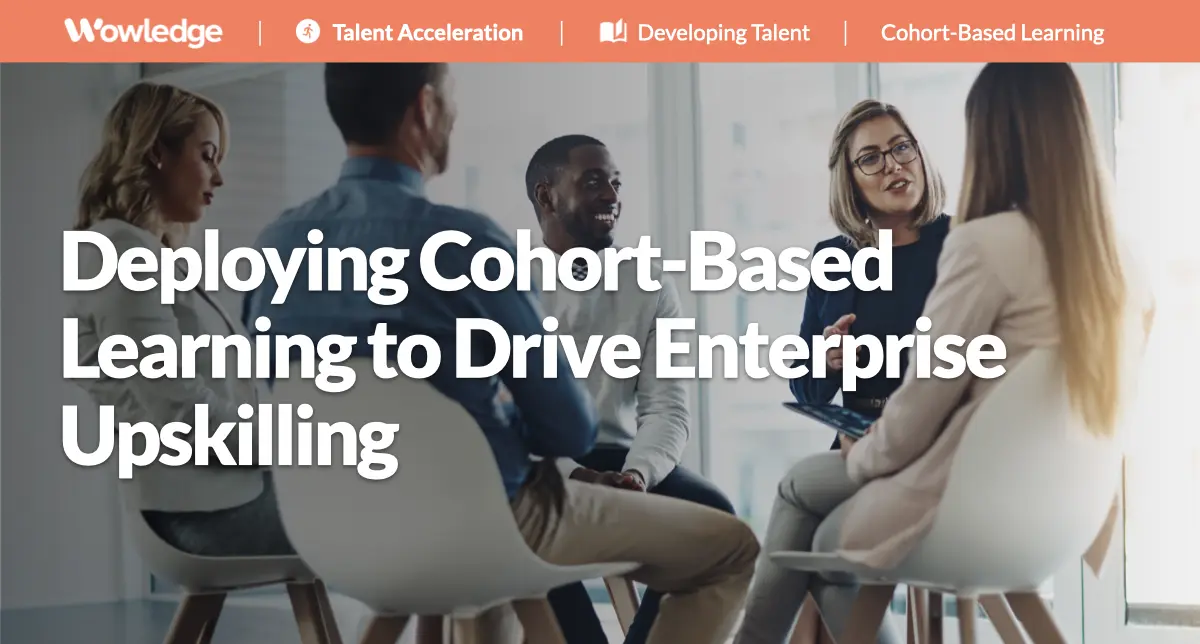
Cohort-based learning is a group-based educational and developmental journey in which groups of employees come together and move through a structured curriculum and set of experiences on a set schedule and timeframe. They work through a combination of individual and group activities that emphasize learning with and through others. It leverages proven learning delivery and experience elements that accelerate understanding, enhance retention, strengthen the ability to apply learning, and develop hard (technical) and soft (interpersonal) skills.
The core design elements include a set timeframe and activity schedule, highly interactive group activities, and shared accountability and commitment. With groups of employees ranging from It relies upon multi-modal learning (e.g., education, experience, exposure) that is delivered in live sessions (virtual and in-person), asynchronously and synchronously, using technology to share, review, comment, edit, and collaborate. It involves instruction, guidance, and facilitation by experienced, skilled leaders. Cohort-based learning uses business, operational, and job-relevant exercises and projects to help participants apply their learning and skills while gaining experience and feedback in a safe, low-risk environment.
Success is based on solid and time-tested theory
This learning and development approach leverages activities associated with skills-based development, experiential learning, and social learning.
It is the last of those three that makes it so compelling as a learning and development journey. Albert Bandura's research identified the effectiveness of social learning, which led to his Social Learning Theory. This showed that people learn by observing others act a certain way and seeing what happens as a result. They then imitate successful behaviors, and when they receive positive feedback for that behavior, it sticks and is more likely to be adopted. Think of an employee who takes the initiative to change how they perform a task, completes it faster or with higher-quality output, and is then publicly recognized by their manager. Under this theory, peers are more likely to imitate them, change how they perform the task, and, once rewarded with positive feedback, adopt that work approach going forward.
The elements or drivers of cohort-based learning at work include:
- Shared accountability with peer visibility into their preparation, attendance, and participation in assigned activities
- Job and work process-relevant assignments, feedback, practice, and support
- Formal group membership, belonging, and collective commitment to acquiring knowledge and skills that offer social rewards and bonds people together
- Collaborative and constructive support for success by teammates
The results can be impressive. For example, Intrepid Learning reported that high-performing organizations offer over five times (5.5X) more collaborative learning versus lower performers. Brandon Hall has shown that companies with comprehensive, high-impact peer-to-peer learning practices and ecosystems achieve 75% improvements in operational performance.

Advantages of cohort-based learning
The elements that define and differentiate cohort-based learning create a uniquely powerful set of outcomes for organizations, generating high-value talent and operational results aligned with improved business performance. By leveraging natural team collaboration and inter-team competitiveness, the human motivation to build social connections and a sense of membership and belonging, and proven impacts on learning efficiency, retention, and broadened application of learned content, this approach delivers many benefits.
Learning outcomes:
- High learner engagement. A highly structured, time-bound approach, with major milestones and a clear schedule, keeps learners on track. The emphasis on group activity and interactivity keeps learners focused and engaged.
- Shared accountabilities and goals. Employees in each cohort share the same requirements for participation, action, completion, and follow-on, which leverages naturally occurring social pressure to conform, work together to meet team objectives, and keep up with assigned content and activities.
- Superior learning retention. Cohort-based learning supports knowledge retention and reinforces skill application by repeating, practicing, explaining, observing others, giving feedback/critiques, and giving/receiving coaching. For example, one large-scale study found that collaboration, even in online learning programs, increases knowledge retention by 20% over individual study.
- Higher completion rates. When compared to individual learning (e.g., eLearning, asynchronous content delivery, research has demonstrated course completion rates of between twice (2X+) and as high as 25-30X for group learning over independent, self-paced courses. This is likely grounded in the social motivations of participating with others vs. watching something on one’s own.
- Higher job relevance. Participation involves high interactivity, giving learners more opportunities to connect with peers and subject matter experts who can ask and answer questions in the moment, provide feedback, and have discussions that can better relate the learning content to their jobs and assigned work.
- Community building. Learners benefit from intensive learning with peers over an extended period, including continuous interactions, shared experiences, support, and relationship building that create a sense of belonging and meaning that drives employee engagement, retention, and purpose.
- Broader viewpoints and problem-solving. Membership in cohorts can be intentionally cross-functional, bringing together people with different technical expertise, role assignments, and business units to expose participants to different perspectives on the business, new problem-solving approaches, methods, and tools.
- Enhances development of soft skills. Unlike other learning delivery modes, cohort-based programs naturally require and support skills related to collaboration, teamwork, and facilitation. Particularly when using trained, skilled cohort facilitators, moderators, and mentors, skills can be intentionally and effectively developed through feedback and coaching, group discussions, and team-building/dynamics sessions. Essential skills related to emotional intelligence (EI), active listening, conflict management, and giving and receiving constructive feedback can be purposefully embedded into cohort-based learning.
Organization and operational outcomes:
- Drives enhanced innovation. With cohort membership bringing together employees who do not normally work together, expanded and enhanced network building is a natural outcome. Even when cohorts are from the same function (e.g., sales, operations, finance), mixing peers from different business units, facilities, or product/service lines leads to sharing and spreading new ideas, approaches, and perspectives.
- Supports a continuous learning culture. Cohort-based learning makes learning more engaging, socially gratifying, and is often viewed as more fun than traditional instructor-led training (ILT) or eLearning. It brings more people together and encourages leadership to prioritize, support, and fund highly visible learning and development offerings. Top leaders champion the importance and value of growth and skill development aligned with the organization's strategic priorities.
- Enables organizational capability development at scale. Cohort-based programs, which range in size from 8- 25 employees each, bring larger-scale upskilling to more employees simultaneously. This allows for training and building organizational capabilities faster and more efficiently,
- Develops shared language, concepts, and methodologies. Group learning helps more people develop a common vocabulary, along with awareness and skills in new approaches or work methods. This enables broader adoption and standardization around leading practices.
Applications for cohort-based learning
This approach to group learning can be effectively deployed in many settings and circumstances, and used to develop knowledge and skills beyond purely technical subject matter. The advantages and value shared in the previous section can serve as guideposts for determining the types of applications where it is most useful. For example, social networking and high engagement make it a natural fit for new-hire onboarding programs, while high interactivity and peer-based sharing and learning contribute significantly to developing leaders and managers. With a long history of application across bootcamps (military, coding/programming), high-potential development programs, professional certification programs, MBA, executive education, and graduate schools, it is a proven method for educating and developing employees. As such, consider these use cases for this approach to learning:
- New hire onboarding
- Skills academies
- Team building and skill/expertise development
- High-potential development
- Leadership development
- New manager indoctrination and development
- Critical skill advancement (e.g., sales skills, financial planning for non-Finance, AI for enabling functions)
- Capability development at scale and speed (e.g., introduction of new workflows, application readiness for digital transformations, managing new market entries, new product or service introductions)

Designing and developing a cohort-based learning program
Cohort-based learning and development programs can be established at any level of an organization, from the enterprise to a business unit to a function or even a locality, depending on the need and size of the employee population to be engaged. In every case, the steps to build one are essentially the same, with the selection of specific steps based on the requirements to get executive buy-in, approve associated budgets, and access resources (people, content, technology).
1. Establish a purpose and define learning objectives
Start by aligning the planned programming with strategic business, financial, and operational objectives. Consider which of those will be impacted by creating the program, and build a narrative that explains how the learning will support those. Document the goals and learning objectives to be achieved by the cohort-based program. That means answering questions such as: Why are we doing this? Who are we targeting? What is the urgency and expected timeframe required to upskill the group(s)? What are the specific learning and skills targets that are associated with the strategic objectives?
2. Build a business case for the costs/benefits associated with implementation
An HR business case assesses costs and risks and clarifies the value proposition and projected impact of implementing the cohort-based program. It defines the problem and explains how this approach can uniquely address it. It speaks directly to the needs and preferences of the CEO, business unit leader, CFO, finance executives, and operations leaders by quantifying the budget and expected ROI of establishing the program(s). It should answer questions such as: How many employees will participate? What are the budget requirements? What are the labor costs? The productivity costs associated with pulling people away from their jobs? What are the options, and which approach is most suitable? What is the project plan? How will success be measured?
3. Design the curriculum
Start with learning objectives, then establish a logical order with prerequisites that build on each other. Make sure the curriculum emphasizes blended learning principles by designing weekly lesson plans that combine modalities, such as pre-reads/videos, in-class presentations and demonstrations, group breakout discussions, exercises, and activities. Emphasize collaborative and experiential learning, giving participants ample opportunities to share ideas, comment and critique, and provide feedback on the content and standards learned. Engage learners between in-person meetings with facilitated/guided weekly application discussions or online postings, homework, and guided peer review and feedback.
4. Create a timeframe and schedule
Develop a timeline to deliver the content and activities, including the time participants need away from the job to complete the program. Consider full-time and part-time options, and whether a modularized approach could allow breaks between formal delivery activities, with online reinforcement limiting the total time away from job assignments. Combine synchronous and asynchronous participation to allow for differences in work schedules and time zones. The schedule should be reviewed by the sponsoring executive(s)for reasonableness to gain their approval and support.
5. Identify technology platforms
Review and select available platforms that can be used to inform, coordinate, schedule, and engage participants for both administrative and collaborative purposes. Check for internal technologies and systems that support content creation and file sharing, messaging and discussion forums, visual and live learning/collaboration, cloud storage repositories, and shared workspaces. Ensure systems and apps are mobile-ready and optimized to support remote, traveling, or deskless workers.
6. Assign facilitators as guides and moderators
Cohort facilitators or moderators can be full-time or part-time, depending on the intensity, length, and depth of a given program. Full-time facilitators support multiple (2-4) groups and are often experts in learning delivery, facilitation, coaching, and oversight of cohorts’ progress, activity performance, and team dynamics. Properly and carefully identify, select, and assign subject matter experts to guide and oversee cohorts. Define criteria and assess them rigorously. Select using criteria including subject matter and interpersonal expertise, and train/develop them to fill skill gaps related to facilitation, behavioral observation and scoring, feedback, and coaching skills.
7. Select participants and place in cohorts
Cohorts should have 10-30 participants, depending upon the complexity of the content and learning objectives, and the mix of skills and job/experience levels. Criteria should be identified for the ideal mix of function, education, experience, job experience, career levels, business unit, and geographic location. Consideration should be given to mixing employees from different career fields when the subject matter allows (to enhance the breadth of problem-solving expertise), and across types of functional roles (e.g., system administrator, programmer, software engineer, cybersecurity specialist) where more restrictive content is the focus of the cohort-based learning program.
8. Facilitate individual and group learning
The approach of the facilitator, mentor, or moderator should balance individual learning and progress with that of the larger team. They should watch for individuals who may be struggling to grasp or apply the material, and be prepared to support and accelerate their learning to keep everyone moving. At the same time, cohort members should be actively encouraged to reach out to their teammates to both offer and request assistance. Group mentors should stay in regular contact with cohort members, check in with individuals to assess their status and engagement levels, and monitor the progress and quality of their group activity and project outputs. Their role is to ensure learning and positive, constructive group interactions.
9. Establish learning assessment mechanisms
Embed learning measurement in the business case, learning content, and moderator role requirements. A blend of learning evaluation approaches can be used to best and most objectively assess learning progress. Consider the use of in-course “knowledge checks”, targeted skill assessments, and certification tests of individual learning and grasp of material are all robust choices. At the same time, expert observer evaluations of assignments, project contributions, team-supporting behaviors, productivity, and cohesiveness can generate invaluable insights. Mentors or moderators should also use those insights to provide feedback and coaching as part of the learning experience.
10. Consider other special, high-impact elements
More mature or advanced methods can accelerate and strengthen cohort-based learning and motivate increased team member participation and engagement. These include:
- Cohort vs. cohort competitions with project presentations reviewed and scored by sponsor executives
- Gamification with skill badges or proficiency level awards earned, or peer and facilitator recognition
- Expert forums or conferences that provide exposure to senior leadership, such as conferences where individuals or cohorts present their business cases or have strategically important projects explained and assigned by top leaders.

Relevant Practices & Tools
Advanced Learning and Development Practices to Accelerate Skill and Capability Growth. >
These practices focus on developing, staffing, and managing a learning and development function that is highly responsive to business needs, employing both technology and non-classroom methods to effectively enhance employee knowledge, skills, and abilities (KSAs)... more »
Facilitating Networks Inside the Organization to Foster Informal Collaboration. >
Informal relationships that operate outside the formal hierarchy can strongly influence how work gets done and value is created... more »
Creating Group Coaching and Mentoring Programs to Broaden and Syndicate the Potential for Impact. >
As a coaching and mentoring culture progresses, its effect is felt throughout the organization. The key at this level is to syndicate the use of coaching and mentoring deeper into the ranks... more »
Creating a Learning Culture that Supports Career-long Education and Development. >
A learning culture encourages and supports the organization and its employees' ongoing pursuit of knowledge and growth, promotes the sharing of learning with others, and motivates everyone to continually upgrade their knowledge, skills, and abilities... more »
The Learning Plan: Outline Learning Objectives, Skills, Delivery Methods, and Evaluation Criteria to Guide Effective Development Programs. >
This tool helps structure professional development initiatives by defining what employees need to learn, how learning will be delivered, and how success will be measured... more »