
Table of Contents
- Understanding the education industry
- Major education industry issues and trends
- The impact of HR in the education industry
- The most pressing issues facing education industry HR leaders and professionals
- Solutions and strategies for improving the impact of education industry HR teams
- Relevant Practices & Tools
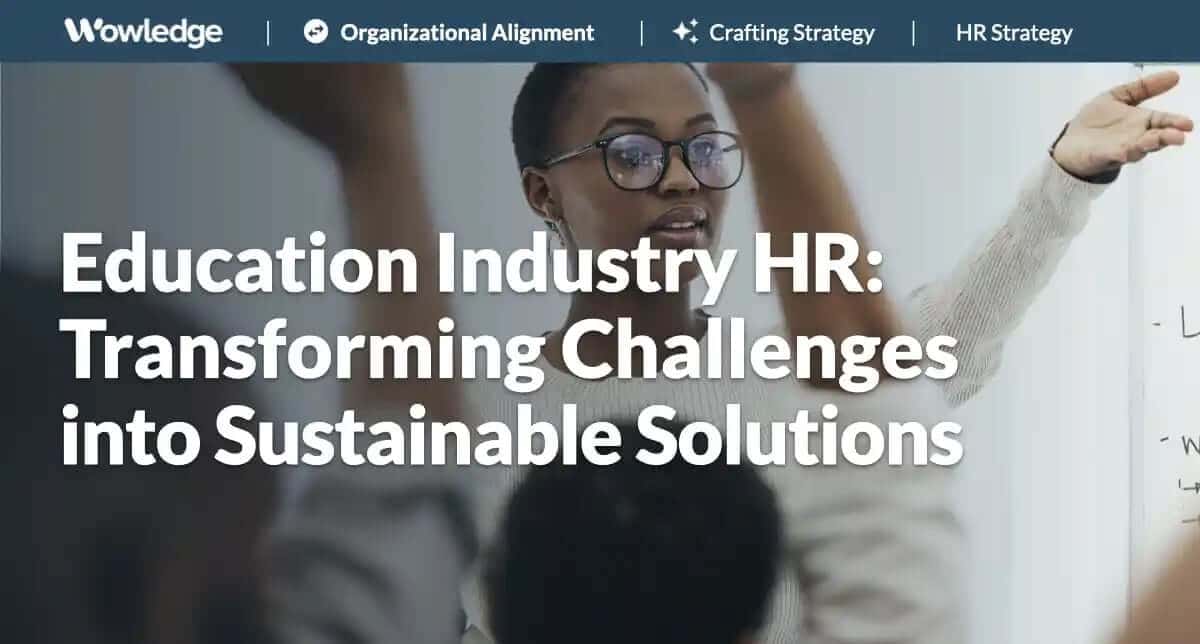
Of all the industry segments across the globe, perhaps none is more important, more closely examined, or more impactful than education. Encompassing public, private, and business providers of and support for structured learning for people at nearly every stage of their lives, it is credited with directly impacting the economic growth of nations, the livelihoods and quality of life of their citizens, and the advancement of public health, civic engagement, and social equity. As a result, the role of education industry HR in driving improved educational delivery and outcomes cannot be overstated.
Understanding the education industry
The education industry generates well over $5 trillion worldwide, with growth estimated at a 4.5% CAGR, reaching $10 trillion by 2030. At that level, it will represent over 6% of the global gross domestic product (GDP). The industry is segmented by targeted learner lifestage and purpose as follows:
- K-12 (55% of all providers). Public and private schools.
- Post-secondary (25%). Higher educational institutions offering college, university, and vocational degree and certificate programs.
- Lifelong or adult learning (8%). Continuing education that is individually pursued, for professional (required and voluntary), or personal learning and skill development.
- Corporate (6%). Employer-funded learning and development programs and technology platforms targeted towards strategically important upskilling and reskilling of their workforces.
- Pre-Kindergarten (8%). Early childhood education is designed to prepare children for success in K-12 education.
The U.S. Bureau of Labor Statistics (BLS) reports that the industry employs over 4 million workers, with about 75% in the public sector (local, state, and federal governments. The preponderance of public teacher unions accounts for a 15% union representation across the industry. Teacher shortages account for the bulk of the BLS's estimate of over 100,000 job openings at any given time.
Union representation is a major factor in the planning and work of HR professionals in the public education sector. Union contracts define work rules, performance management standards, and processes, which can restrain the ability of administrators and HR teams to innovate and make certain policy and program decisions. As they face constrained tax-based budget challenges, they must account for higher salary and benefit levels than those of private educational institutions and organizations. For example, the BLS reports that union-represented workers earn an average of $100 per week more than their nonunion peers, and that 90% of the state and local teachers have access to defined benefit retirement (e.g., pension) plans, which are more expensive to provide and maintain than defined contribution (e.g., 401k) plans, which 69% of private sector workers have access to.
At the same time, the corporate training and development market, led by educational technology (EdTech), is the fastest-growing industry segment, with strong demand for digital learning platforms to efficiently deliver individually tailored content. With skills obsolescence and rapid automation, robotization, and AI adoptions (among many other factors) creating increased cross-industry requirements for upskilling and reskilling, more efficient and effective learning design and delivery systems are in high demand.
Major education industry issues and trends
Aside from the longstanding challenges facing the industry as a whole, new and emerging trends are creating additional headwinds for leaders, requiring their attention and responsiveness.
- Decreased funding: Public institutions face ongoing pressure and scrutiny amid rising tuition, declining enrollments, and increasing costs, while enduring reduced state and federal allocations, grants, and student loan availability.
- Work and labor force alignment: Growing calls are being made for traditional learning institutions to better align academic training curricula and skill development methods with specific job market requirements.
- Technological advances: The industry is increasingly under pressure to adopt tech-enabled learning that is personalized (in content and delivery), asynchronous and self-paced, virtual/hybrid, and includes administrative process automation.
Further issues are facing the primary industry segments that require attention, resources, and responses. Those specific to each segment include:
Public K-12 education
Employing four million teachers across 98,600 public schools, and serving an estimated 49 million students, the K-12 segment continues to suffer from teacher shortages and high turnover due to teacher burnout, under-resourcing of classroom materials and equipment, excessive administrative task burdens, large class sizes, limitations of professional development resources and availability, and a plethora of student behavior and support issues. Local community pressure has increased regarding the courseware, subject matter, and the required reading/learning materials on which those are based. Making matters worse are decreases in local, state, and federal funding that disproportionately affect school districts in smaller-population and/or lower-socioeconomic-status locations, both of which already have lower tax bases. While their private school counterparts can raise tuition to address some of those issues (especially increased costs and budget requirements), their teachers and staff are not immune to the same classroom and professional development challenges.
Postsecondary education
Colleges and universities have received a great deal of attention regarding career preparation and the applicability of curricula, the value of major areas of study, and even the political leaning of their course content and professors/instructors. Perhaps more concerning is the growing consumer wariness and eroding confidence about the costs of college attendance vs. the value of a college degree, with Deloitte research showing a major drop in confidence from 58% to 36% over the past 10 years alone. The loss of trust in those institutions can be traced back to the collapse and federal government crackdown on for-profit colleges, whose promises of post-graduation employment suited to the completed degree program fell well short.
The issues have multiplied amid political pressures that have led to restricted research funding, potential tax-endowment fund income (which is being used to lower student costs and fund research), and cutbacks in student loan availability and lowered borrowing caps, causing major financial challenges for many of these institutions. Due largely to a combination of reportedly steep rises in overhead costs, led by student health care, mental health, and insurance premiums, and student population drops, the most alarming trend has emerged: the closures or mergers of colleges, recently averaging one per week, with more than 40 closing since 2020.
At the same time, vocational and trade school enrollments have been steadily rising (4.9% per year), while college enrollments have declined, especially among males and foreign students, who pay significantly more in tuition than their U.S. classmates. In fact, those schools are enjoying an 11% increase in revenue, with interest among Gen Z and Gen Alpha having doubled in response to the skyrocketing costs and staggering loan amounts required to attend and complete a traditional four-year college degree program. Community college and two-year junior college enrollments have jumped up 20% in the vocational and trade programs. The leading career program enrollments are coming in culinary arts, beauty and wellness, and healthcare.
Corporate education
The corporate education and training market, valued at over $360 billion, addresses the content and delivery of subject matter most concerning to organizations, with employee upskilling, reskilling, leadership development, and compliance training the primary areas of focus. It is a segment that HR leaders and professionals in the education industry are well acquainted with. It will come as no surprise to them that the products and services provided by a combination of external vendors and internal corporate functions continue to experience significant levels of growth and expansion.
The principal trends are related to 1) upskilling of employees as advanced technologies are adopted, related to AI, robotics, and process automation, and 2) reskilling of workers impacted by many of those same technological advances, and continuing search for greater efficiencies and cost-effective business approaches. At the same time, the effectiveness of leadership and management is lagging across industries, and the need for more impactful solutions is driving corporate investments and initiatives to ever higher levels.
Educational Technology
It is unsurprising to many that technology has become an essential partner in education across schools, universities, vocational, corporate, and adult learning. Benchmark International estimates that the proliferation of these “EdTech” platforms, tools, and content repository products has now reached between 40,000 and 50,000 available in the global market. So much so that venture capital investments have reached record levels that are projected to generate strong annual growth rates for the foreseeable future.
Examples of the primary forms and types of EdTech platforms include:
- Learning management systems (LMS) that house and distribute coursework, grades, and other classroom management systems.
- Student information systems (SIS) that manage student administration, such as attendance and scheduling, and others that safeguard and monitor student online activities.
- Online Course/eLearning platforms that house and deliver content, including curated content repositories and Massive Open Online Courses (MOOCs).
- Assessment and testing platforms that support test building, distribution, and administration of standards-based testing, gamified polls and quizzes, interactive assignments, and proctoring and identity verification tools.
- Collaboration and communication tools that engage and connect students and instructors in information and idea sharing, document co-authoring, digital bulletin boards, interactive chatting, inquiries, and support.
The rapidly expanding application of AI and machine learning (ML) capabilities by EdTech vendors is increasing the availability of personalized learning, ranging from individually tailored lessons to learning path recommendations to targeted tutoring for students at all stages of development and across types and levels of ability (and disability). Similarly, virtual and augmented reality tools and methods are being applied across a wide range of learning topics where quasi-experiential learning can accelerate knowledge and skill acquisition and refinement.

The impact of HR in the education industry
When HR functions move beyond the basics of job postings, interviewing, grievance handling, and record-keeping into more modern practices, education industry HR leaders who introduce advanced approaches help their organizations flourish. For example, increased “intensity” of a fuller suite of leading HR practices has been shown to significantly impact academic and corporate performance, with significant effects on financial, productivity, and absenteeism outcomes. That comprehensiveness included a combination of more advanced practices and processes related to employee selection, team effectiveness, employee engagement, incentives and rewards, goal setting, and employee listening. is positively associated with improved performance for schools and non-schools as measured by the additive
Another study found that organizations with more structured and advanced HR policies achieved superior employee performance, productivity, engagement, and commitment to organizational objectives. It found that the biggest drivers of those outcomes were training and professional development, incentive and recognition programs, and career development and advancement.
The most pressing issues facing education industry HR leaders and professionals
While the range of responsibilities and challenges facing education industry HR experts is shared with those in most other industries, the unique environments and circumstances in which they manage these responsibilities and challenges create an additional layer of complexity. Consider, for example, the fact that many educational institutions are publicly or privately funded, which imposes limitations on the revenue and investment-generated budgets. Their compliance requirements, much like those in other industries such as healthcare and construction, are layered with laws and regulations imposed by legislators and voters at the federal, state, and local levels. In a similar vein, their stakeholders often make demands that influence the subject matter, teaching methods, standards, and budget allocations deployed in the name of meeting their mission and purpose.
With those constraints in mind, education industry HR professionals commonly face issues such as:
Staff shortages
Public and private institutions struggle with job openings and related staffing issues for programs and classes. Lower salaries and lower employee career satisfaction hinder the ability to attract and retain qualified, motivated educators and administrators. Employee burnout and turnover rates are exacerbated by many who leave the industry in search of lower-stress, more meaningful, and better-paying jobs, resulting in fewer experienced workers available in the labor force.
Burnout and stress
Industry professionals and academic researchers report widespread educator exhaustion and frustration, driven by workloads (from increasingly large student-to-teacher ratios), shortages of classroom tools and materials, inefficient work processes, and ongoing difficulties in managing student behavior and underachievement. Under-resourcing is linked to a perceived lack of support and respect, which is driving experienced educators away and shrinking the available pool of replacements. Most concerning is that the problem is broader than turnover: a large-scale research study in the Journal of Educational Psychology (April 2016) on teachers’ emotional exhaustion demonstrated a relationship between the exhaustion and significantly lower levels of student achievement in mathematics.
Designing and implementing professional development programs
A major complaint among K-12 workers in this industry is the lack of development they need to keep pace with advances in learning methods, subject-matter expertise, classroom management, student behavior, and skills and topics relevant to career growth and advancement aspirations. The concerns appear well-founded, as teacher and administrator workloads are impacted by bureaucratic, time-consuming administrative work, limitations on time away from student-facing responsibilities, budget constraints, and resourcing that supports access to and availability of learning suitable for the full range of subjects taught and the skills needed.
High leadership turnover rates
The consistency of financial well-being, academic achievement, and production at the postsecondary level is often tied to the quality of leadership, which has emerged as a major issue for HR leaders in colleges and universities. Deloitte recently reported that the turnover rate among top leaders has climbed to an unprecedented high of over 20%. In fact, both Chief Academic Officers and Chief HR Officers have annual turnover rates of 25-30%, with average tenures of less than 5 years. The pressures institutions face make the roles harder to manage and maintain.
For education industry HR leaders and teams across the institutional segments, efforts to modernize and expand capabilities and services for strategic HR support are hampered by a unique issue: the CHRO’s placement in the organizational hierarchy. McKinsey has reported that CHROs most often do not report directly to the university president and are unable to influence strategic activities typically handled by corporate HR teams, such as workforce planning and hiring processes (especially for professors, researchers, and other academic roles).

Solutions and strategies for improving the impact of education industry HR teams
As demonstrated, the ability of education industry HR leaders and professionals to drive higher levels of performance, productivity, engagement, staffing, and retention is substantial. It requires strategic thinking, resourcefulness, creativity, and an appreciation of the needs of leaders, employees, stakeholders, and the communities being served.
The key to success is for industry HR insiders to understand the value chain linking well-prepared, motivated, and resourced teams to the elevated learning outcomes achieved by students and learners. That focus on driving better learner outcomes should be held closely as the primary purpose of the HR function.
1. Embrace process improvement and automation
Listen to teachers, employees, administrators, and even the HR team, and identify opportunities to reduce the burden of outdated, under-optimized systems or manual processes on their time and effort. Engage them in identifying opportunities to improve process efficiency and effectiveness and in using existing EdTech or more advanced AI applications to digitize and automate repetitive processes. Leading education industry HR teams should rely on approaches such as Lean, Kaizen, or TQM to streamline the way required tasks are accomplished. For example, one UK study found that reducing teachers’ workload by 5 hours per week could yield a 1% increase in retention, making a considerable impact on teacher supply.
2. Increase diversity in candidate attraction and hiring
With estimates of public school teacher demographics (77% Female, 72% Caucasian) per the Bureau of Labor Statistics and Pew Research Center, and 54% of their students identified as non-white, the opportunity to overcome teacher shortages can lie in education industry HR teams efforts related to the outreach, attraction, and hiring of this otherwise non-traditional labor force. Given that private-sector employment has stagnated, college-educated professionals may be drawn to more stable local education districts. The availability of job security, robust benefits and retirement plans, and work sites close to their homes and communities can make this an attractive option.
3. Focus on leadership and succession management
The need for leadership and management development has perhaps never been more critical for education industry leaders. Reassessing the competencies and skills required to perform those jobs is an essential step, with consideration given to enhancing their adaptability, resilience, resourcefulness, critical thinking, creativity, and the ability to manage ambiguity. Developing or identifying learning resources related to those, and developing selection and promotion assessment techniques that evaluate and compare those capabilities, are critical elements towards preparing and advancing those most capable of handling the challenges. Similarly, using those same criteria to identify, evaluate, and develop high potentials (HiPos) and to create development plans to advance them helps better prepare a pool of future leaders.
4. Prioritize engagement and employee experience
Much like employee engagement has long been shown to drive performance, productivity, and retention, the value of creating a compelling employee experience (EX) yields equally compelling results and serves as a significant differentiator in an employer value proposition. The two can be achieved by engaging employees in streamlining their work processes, using employee listening to identify “pain points” and the (often small) things that cause frustration, and leveraging design thinking approaches to improve the elements of their work and work lives that most drain them.
5. Support employee wellbeing
Given the levels of stress and burnout that have become commonplace, providing targeted support for employees' mental, physical, and even financial health and well-being is essential. Education industry HR teams should work to support this through widely available online platforms, tools, and resources that offer a range of solutions that combine existing benefits (healthcare plans, EAPs) with free community- or vendor-based services and assets. Consider offering breaks, group meditation and exercise opportunities, and expert-led seminars and webinars on topics such as exercise and fitness, heart health, financial planning, or debt management and reduction.
6. Establish effective, low-cost development solutions
Offering effective development does not have to be an expensive journey. Provide access to curated sources of free education (Udemy, Coursera, EdX) for knowledge updates during breaks or after hours. Education industry HR can organize and facilitate peer-based mentoring and group coaching circles on topics related to managing stress, students, and classrooms, which can be highly impactful and cost-effective learning opportunities when conducted during lunch or before/after school hours.

Relevant Practices & Tools
Advanced Lean HR Practices to Evolve HR into a Strategic Business Partner in Organizational Transformation. >
Lean HR teams must adopt a learner’s posture—curious, data-driven, and open to feedback—even when it reveals legacy practices that no longer serve the organization’s needs... more »
Developing Leaders Across Multiple Levels of Management. >
Advanced leadership development is designed to not only develop current executives, but "leaders" in all levels of the organization... more »
Identifying and Calibrating Successors and HIPOs for Each Role Through Structured and Standardized Assessment Sessions. >
Naming potential successors for executive and critical roles is a collaboration between leaders that requires thought, preparation, and discussions... more »
Using Formal Multi-dimensional Assessments to Enhance Candidate Evaluation Objectivity and Accuracy. >
The most common candidate evaluation criteria in use address the fit between a) job skills and experiences and the role requirements as defined in a job description, b) work style and role expectations, and c) motivations to perform the tasks in the new role... more »
The Individual Development Plan (IDP) Tool: Capture Targeted Employee Learning and Development Actions for a Performance Period. >
A plan of action to guide the employee throughout the coming performance period (e.g., year) as they continue to develop necessary knowledge, skills, abilities, and competencies for both meeting current and preparing for future job role requirements... more »