
Table of Contents
- Understanding the work and staffing of the public sector: The basics
- Challenges facing public sector HR leaders and professionals
- The unique employment-related advantages that public sector HR teams can leverage
- Strategy and tactical recommendations for public sector HR teams
- 1. Modernize talent attraction and recruitment
- 2. Leverage HR technologies and analytics
- 3. Expand succession planning
- 4. Reimagine performance management, rewards, and recognition
- 5. Develop knowledge management capabilities
- 6. Emphasize and strengthen employee development
- 7. Focus on improving the employee experience
- Relevant Practices & Tools
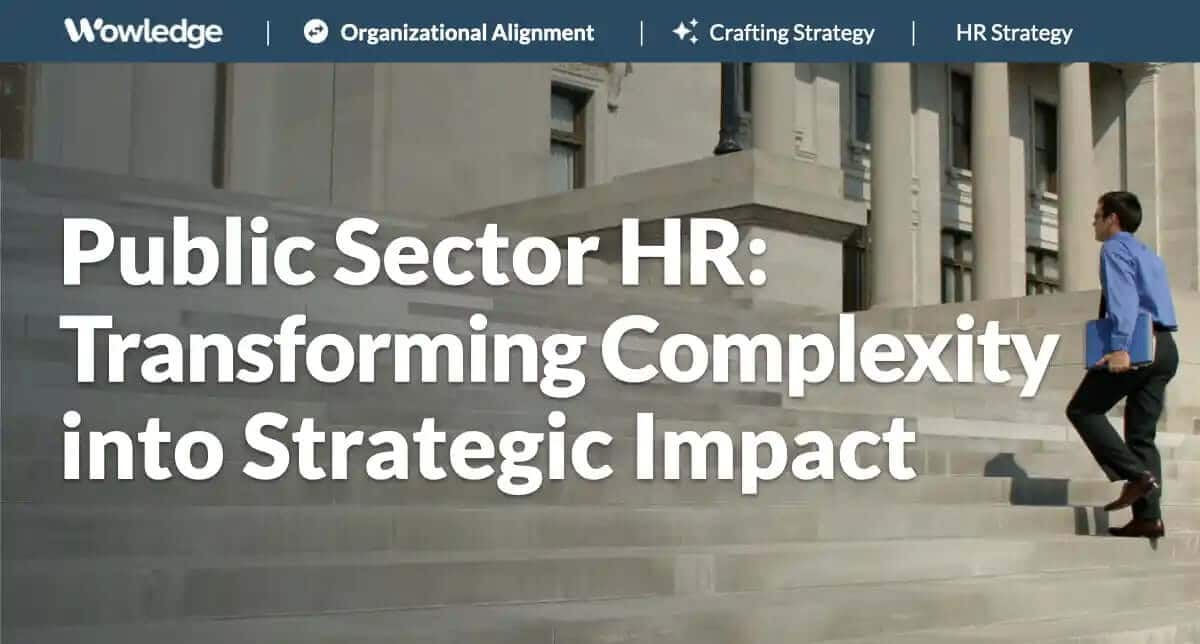
In the United States, the second largest industry segment is known as the “public sector”, which is made up of federal, state, and local government entities. In the aggregate, it is the nation’s largest employer, with over 23 million workers across a vast array of professional and job classifications (estimated at over 350). Representing about 14% of total U.S. employment, the public sector's scale and variety of roles alone make public-sector HR work challenging, but the range of complexities those teams face is vast and deeply embedded in their everyday work and decision-making. Despite the challenges of managing work, development, careers, and organizational culture(s), there are significant benefits to be leveraged to build successful and meaningful workplaces and environments.
Understanding the work and staffing of the public sector: The basics
Public sector HR professionals operate at every tier of government and understand the value proposition of those at different levels—federal, state, and local. Many casual observers are surprised to discover that, of the three distinct tiers, local governments employ the most (14.2 million), followed by state governments (5.4 million) and the federal government (2.3 million non-military and 2.1 million uniformed).
The reason for such large employment bases at the local level? Consider how many teachers, police, and fire personnel are required to support local needs.
In fact, the types and level of services required to support communities and cities vs. states and the nation differentiate the employment bases of each. For example:
- Federal government - defense, postal services, and administration dominate
- State governments - infrastructure, transportation, health and human services, corrections, education, and labor.
- Local governments - education, protective services (Police, Fire), and administration.
While federal employment has decreased over the past 12-18 months (290,000, according to Forbes), it remains a substantial labor force. At the same time, the National Association of State Retirement Administrators reports that state governments have shed almost 35,000 jobs while local governments have created an additional 82,000 jobs.
Interestingly, according to the Pew Research Center, 92% of federal workers are white-collar employees, and almost 17% work in medical or health-related occupations.

Challenges facing public sector HR leaders and professionals
Public sector HR teams must deal with a broader range of issues than their private-sector peers. While some are the same (e.g., general labor market shortages), they are complicated by a range of unique characteristics of governmental employment environments (e.g., publicly funded and monitored). As a result, those challenges tend to become interwoven, making them more difficult to address. However, for resourceful and innovative HR leaders who operate with a strong understanding of the environmental factors and the leadership they support, many of these offer unique opportunities to improve the mission and people-related outcomes sought by the agencies themselves. That said, the complications they need to manage include:
Recruitment and retention
High job vacancies are a mainstay of today’s public sector employment environments, particularly at the local level. The reasons include:
- An aging government workforce, with almost 40% of knowledge workers eligible for retirement in the next 10 years, and over 33% of state and local knowledge workers similarly positioned, according to the U.S. Census Bureau.
- Governments employ specialists across some 350 occupation groups, creating substantially more difficulties with effective and coordinated recruiting, workforce planning
- Pressures to attract and hire replacements at the federal level in light of widely reported staff reductions, agency and facility closures or relocations, and politicization of hiring standards and decisions.
- Slow, ineffective hiring processes, with an average of 43 days from application to interview, versus an average of 20 days in private sector employers.
- Lower salaries and wages make it more difficult to attract and secure new hires. The Congressional Budget Office reports that Federal employees earn, on average, 24.72% less in base salary (although their welfare and retirement benefits are higher valued), and that local government employees earn about 22% less than similarly skilled and placed employees in the private sector.
Constrained budgets and resources
Directly related to the wage-and-salary issue is the ongoing challenge of managing limited funding, driven primarily by reliance on residential and business taxes. As the costs of labor, facilities, equipment, supplies, fuel, maintenance, repairs, and insurances needed to fund and sustain continue to rise, so do the costs of providing services related to national defense, public safety, pensions and social security, public healthcare and welfare programs, and education. As a result, public sector HR and finance teams face significant pressure to manage expenses and budgets, making it challenging to secure desired investments for improvements.
Accountability and compliance
Ongoing public scrutiny of the effectiveness and perceived fairness of administrations’, agencies’, and bureaus’ direction, programs, spending, and decisions is amplified by legislative oversight and media coverage that span the spectrum of political and cultural perspectives. The expectations of full transparency and legal/regulatory compliance make planning and performance continuous sources of pressure.
Unions and civil service protections
Public-sector unions represent 32.9% of all workers compared to only 5.9% of private-sector workers. While around 20% of federal workers are unionized, the local government ranks are the most highly organized, with 37.8% of all employees covered by union contracts. The largest locally represented occupational groups are teachers, police, and firefighters. In fact, the Economic Policy Institute reports that state and local government employees represent the largest single grouping (42%) of all union members nationwide.
The presence of unions creates specialized requirements for public sector HR and agency leaders to manage union contracts, labor rates, and higher labor costs (especially given defined wage escalation schedules and rich pension and health benefits). More demanding are the elements of those contacts that, compared to non-unionized organizations, can restrict operational and personnel flexibility and adaptability, such as managing complex civil service regulations, restrictive work rules (e.g., hours of work, scheduling, ability to discipline and terminate), and people management policies and practices (e.g., tenure-based pay, seniority-based advancement and mobility). Furthermore, federal union contracts do not allow strikes; the same applies to covered state- and local-level workers in most (38 states), with public health and safety requirements codified in law.
Outdated systems and processes
Public sector HR, IT, procurement, and administration functions are challenged and constrained by what is termed “institutional lag,” driven by a number of factors, including difficulties in securing sufficient financial resources to support more advanced capabilities. The opportunities for more efficient expense management are legion, many due to long procurement cycles and risk-averse management cultures tied to outdated processes and legacy information systems. The situation is made worse by the fact that any new system or process can directly affect not only the work of hundreds of employees, but the welfare and well-being of millions of people and businesses, or hundreds of millions of citizens, requiring extensive communication, training, and government support.
As an example that public sector HR professionals will relate to, 76% of government agencies have not yet adopted what is perhaps the most widely implemented AI use case: AI-enabled recruiting capabilities. And 78% of those organizations have yet to develop and distribute policies and procedures related to the use and appropriate applications of AI technologies. Perhaps more telling, only 9% of those agencies use mobile apps for job applications.
The unique employment-related advantages that public sector HR teams can leverage
Despite what may appear to be myriad challenges facing public-sector HR and leadership teams compared with those in the private sector, there are compelling benefits and opportunities for government workers. Each of these can be promoted as reasons to consider public sector employment and should be targeted for related policy, process, and program enhancements and refinements.
More employment stability
Government jobs generally offer more job security, and better pensions and benefits. As the job market softens and economic uncertainties increase, public sector employment can offer significant advantages to those concerned with stability. Revelio’s research found that the attrition rate is 30% lower in state and local governments than in the private sector. For workers at all levels who value stability, consistency, longer-tenure career opportunities, and robust retirement and healthcare benefits, public-sector careers can offer significant opportunities.
Mission and meaningfulness of work
While many private sector employees complain about profit pressures, short-term goals, and an unclear or questionable value proposition for the community or humanity, public-sector HR teams know that their organizations offer something unique—a human-centric mission or purpose. So many government agencies, bureaus, and departments were established to help people by improving the quality of life, educating them and their children, safeguarding their homes and neighborhoods, providing assistance and support when they fall on hard times, and building, improving, and maintaining the physical infrastructure and conveniences they rely upon. Government workers at all levels can point directly to how their work contributes to public well-being and welfare (i.e., meaningfulness). For many in the private sector, that kind of attachment of their work to a greater end is severely lacking.
Breadth and availability of occupational options
As noted earlier, the public sector employs workers in an estimated 350 occupations, from manual laborers to tradespeople and technicians to professionals and leaders. The sheer volume of open jobs, many with clearly defined advancement requirements and opportunities, gives motivated individuals the chance to apply their skills across an amazing range of work environments through growth, cross-functional promotions, and transfers.

Strategy and tactical recommendations for public sector HR teams
Effectively addressing the range of needs that public sector HR teams face requires strategic thinking, deep operational knowledge, strong coaching and influencing skills, resourcefulness, creative problem-solving, and a commitment to continuously improving workforce effectiveness and impact. Even with limited budgets and resources, public sector HR teams can leverage strategies and tactics proven effective in both public and private sectors to make stronger, more impactful contributions.
1. Modernize talent attraction and recruitment
Building a more effective talent acquisition capability does not necessarily require upgrading applicant tracking and candidate relationship management technologies, although they do offer compelling efficiencies. Process improvement efforts can be led by HR and are even more effective when end users (recruiters, line managers, new hires) are directly engaged using design thinking methods. Equally cost-effective is the creation or updating of an employee value proposition (EVP) that focuses on the benefits of, and purpose-driven nature of, public service.
Collaborate with union leadership to strengthen talent pipelines with internships, boot camps, apprenticeships, and accelerated skill development programs that support covered employee mobility and advancement opportunities. Take advantage of private-sector entry-level hiring slowdowns to attract new workers and aspirants from the trades to business and finance, and STEM graduates (including those from the most prestigious universities) whose private-sector opportunities are being squeezed by layoffs and staffing reductions.
Embrace skills-based job requirements and hiring practices to open up opportunities for highly capable, non-degree workers seeking stable careers. Finally, consider formally assessing candidates on how well they match the agency, bureau, or department's culture and work style, and the extent to which they are aligned with its mission and values, and are motivated to work in more stable, structured, and process-compliant environments.
2. Leverage HR technologies and analytics
Taking full advantage of available systems and data to identify trends in hiring, performance, tenure, and turnover, and to identify process gaps and pain points, and to make evidence-based decisions is crucial. Engage local college students majoring in analytics, statistics, or data science to create repeatable analyses of workforce trends, HR program or process impact, or talent KPIs (e.g., training received, competencies attained, length of service) and their impact on operational outcomes. Using permitted technologies, take advantage of opportunities to experiment with generative AI for taking meeting notes, summarizing reports, or searching for new insights from historical documents and data in a knowledge warehouse. Work to design AI Agents capable of breaking down complex goals into actionable steps, or handling routine, complex workflows such as customer support, scheduling, or data entry.
3. Expand succession planning
Extend formal succession planning processes beyond managing senior-level retirements to include planning for the loss of key role holders—especially at the subject-matter expert level within critical workforce segments. Consider the average years to retirement eligibility for the most seasoned and broadly experienced team members, the potential loss of institutional knowledge and expertise, and make plans to hire or develop others under their tutelage or mentoring.
4. Reimagine performance management, rewards, and recognition
Understanding that base pay rates are substantially lower than those available for peers in private industry, public sector HR professionals should lean into making changes to how performance is directed, monitored, and rewarded, with or without additional funding. Start by creating a performance goals structure in which teams identify objectives that flow from, align with, or contribute to those of their agency, then have team members and the manager articulate their individual goals.
Next, install processes and resources, then train managers to hold brief, weekly or biweekly performance “check-in” sessions focused on coaching and addressing employee needs. Follow that with managerial and peer recognition practices that target specific team and individual behaviors, outcomes, and improvements aligned with the agency, department, and individual goals, and establish tracking and reporting for both. Wherever possible, assign portions of available merit increase or bonus funds to a combination of agency, department, and/or individual performance that notably exceed goals or expectations.
5. Develop knowledge management capabilities
Understanding that, despite longer tenures and lower turnover, public sector HR teams must support the preservation of institutional knowledge and expertise to address the aging of expert populations through turnover and retirements. Knowledge management (KM) offers a uniquely powerful value proposition to local and state governments by enabling the capture and sharing/distribution of best practices, lessons learned, and how-to guidance. Consider the range and sheer volumes of problems, issues, and occurrences that happen over a period of years in a single community or town, much less a city, county, or state, on a single topic (e.g., animal control, classroom behavior, water shortages), whose lessons about the circumstances and what worked or failed when handling those.
6. Emphasize and strengthen employee development
The best defense against turnover, low engagement, poor productivity, and managerial ineffectiveness is an offense targeting continuous learning. Create a development environment through whatever resources are available—online content libraries, curated recommendations of free, publicly available learning resources (e.g., MOOCs), internal coaching and mentorship and training programs, and redesigning policies to encourage and enable internal mobility (within and across agencies). Establish communities of practice (CoPs) that bring together similarly skilled (or interested) individuals across departments and functions to engage in peer learning, sharing, coaching, and advising mechanisms. Encourage and recognize managers and SMEs for offering or leading lunch-and-learns, group coaching sessions, or other socially based learning opportunities.
7. Focus on improving the employee experience
The employee experience (EX) addresses how workers encounter their tasks, workflows, and processes, and the extent to which those are easy to access and streamlined to conduct. The objective of an EX improvement exercise is to engage them directly in identifying where they encounter difficulties, delays, or other frustrations (the “pain points”), and then helping redesign those sticking points to relieve their pain.
This can be accomplished frequently without major (or any) investment by simplifying work and administrative processes, removing burdensome, non-value-adding approvals, unnecessary handoffs to others, and repeated data entry of information housed in another (non-integrated) system. Not only does this simplify the work that employees are required to perform every day, but it also builds a culture, values, and expectations that make working at the agency or department more bearable by giving employees a voice and a pathway to constructive action that improves the quality of their work lives.

Relevant Practices & Tools
Core Lean HR Practices to Align HR with Business Strategies and Objectives. >
“Lean” practices represent a methodology designed to impact the entire business system, from defining value in the most differentiating ways to empowering employees to redesign how they accomplish their work to improve productivity and engagement... more »
Identifying and Nurturing Effective Internal and External Talent Sources. >
The effectiveness and efficiency of the recruiting process will greatly depend on the organization’s ability to identify multiple sources of qualified candidates and nurture those channels on an ongoing basis... more »
Creating an Employee Experience that Bonds High Performers to the Organization. >
The employee experience constitutes the entire journey an employee takes with the organization. This includes everything from pre-hire to post-exit interactions and everything in between... more »
Creating a Culture of Internal Mobility that Supports Employee Development and Retention. >
Creating a culture of mobility requires management to accept that the benefits of movement (promotions and transfers) far outweigh the costs of replacing workers in their teams... more »
The Talent Gap Analysis Goal ID Tool: Capture Critical Role Staffing Challenges and “6Bs” Strategic Talent Management Responses. >
This tool incorporates the multi-source staffing strategy that references the “Buy, Build, Borrow, Bind, Bot, and Bounce” options for proactively filling, retaining, and managing critical skill workers as available resources within the organization... more »